
Disclosure: Buytoplab is reader-supported. If you buy through links on this page we may earn a small commission at no extra cost to you. We never accept payment for a ranking or a review, and we publish the downsides as plainly as the upsides. How we rank products.
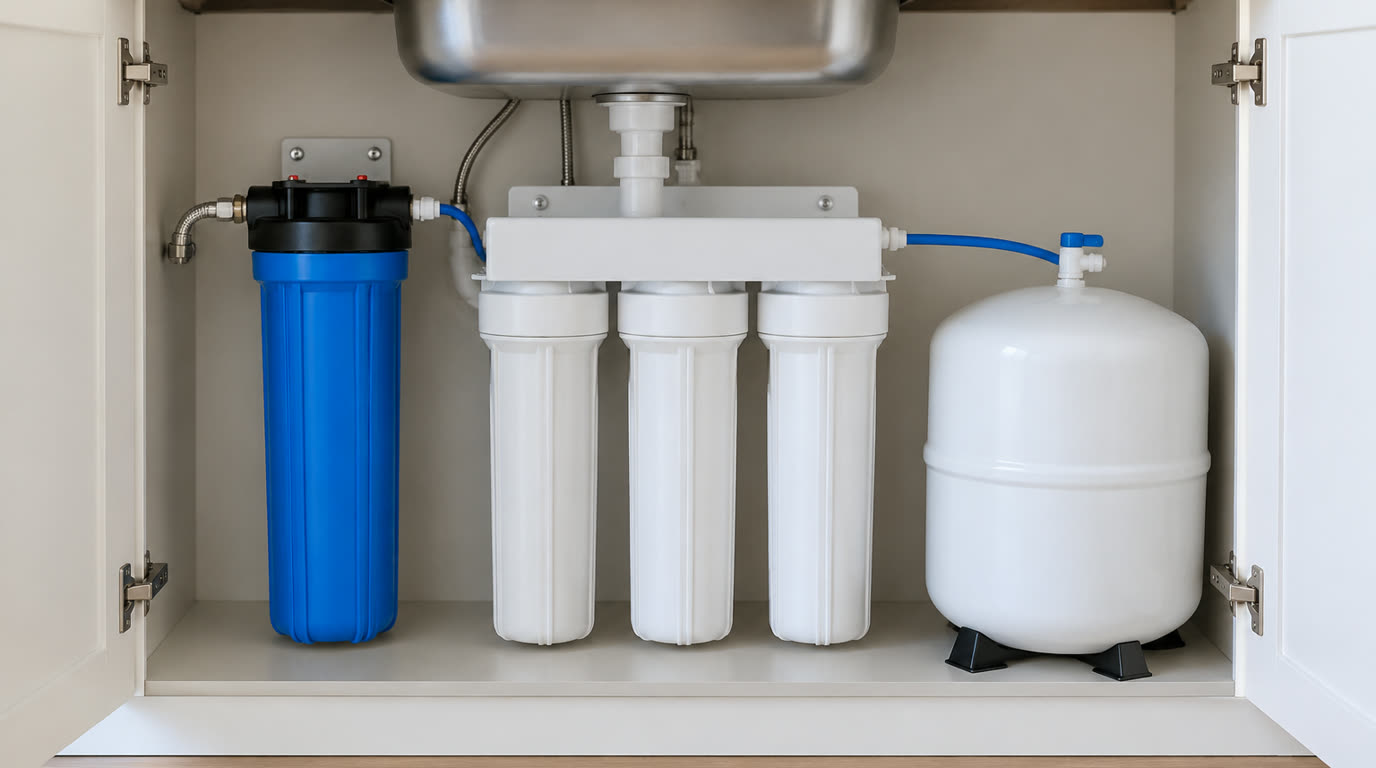
Spend this, not more: These are not all the same kind of purchase. Point-of-use carbon filters and reverse osmosis units are a few hundred dollars. Chemical-free iron systems that treat the whole house run from about $2,290 to $2,825 before the mandatory water test. Two rules keep that in order. If your water test comes back with iron above 3 ppm, the $155 and $231 options will not finish the job, and spending $400 on them is spending twice. If it comes back under 1 ppm of iron with no sulfur smell, the $1,699 whole-house systems are the wrong answer.
Quick answer:
- SpringWell WS1 Chemical-Free Iron Filter ($2,290.04): Handles iron to 7 ppm, manganese to 1 ppm and hydrogen sulfide to 8 ppm with no chemicals and no cartridges to replace. It is also the only system here that makes you test first by design.
- Kind Water Systems WS-AIO Smart Metered Filter ($2,823.52): Same 7 ppm iron ceiling as SpringWell, plus a 5-micron pleated sediment cartridge, and a 120-day satisfaction guarantee with a lifetime warranty behind it.
- Aquasana Rhino Whole House Filter ($999): The best cheap answer to sediment and chlorine on well water, certified to NSF/ANSI 42 for 97% chlorine, rated to a million gallons. It does nothing for bacteria.
- Aquasana Claryum 2-Stage Under Sink ($124.99): The only pick certified to NSF/ANSI 53 and 401, and the only one with a real standard number behind the lead and cyst claims. Half a gallon a minute, 500 gallons per cartridge.
- APEC ROES-UV75-SS Reverse Osmosis with UV ($279.95): The only unit here that treats water from an un-chlorinated well for microbes. 75 GPD reverse osmosis plus a UV stage, WQA certified.
- iSpring WGB32BM 3-Stage Iron Filter ($649.99): Fifteen gallons a minute and 100,000-gallon cartridges for under $650, but its iron ceiling is 3 ppm, which is the real limit to know before buying.
How much should you spend? Two different cost models are being compared here, and mixing them is how people overspend. A point-of-use system is a small upfront cost with an annual cartridge bill: the Aquasana Claryum is $124.99 with roughly a year of media, the iSpring RCC7 is $230.99 with about $125.99 of filters per year, and the APEC ROES-UV75-SS is $279.95 with about $70 per year. A chemical-free iron system is the opposite: a large one-time cost and then almost nothing. SpringWell’s air injection media and Kind’s Katalox Light media are rated in years, not months, so the $2,290 and $2,824 figures are not comparable to the $155 Waterdrop, whose WD-WF10-FG cartridges at $71.99 every three to six months add up to roughly $144 to $288 a year. That is more than the entire purchase price of a Claryum within two years. The cheapest way to spend well is to let the test decide the category: under 1 ppm iron and no sulfur, spend a few hundred; over 3 ppm, the only two systems here rated for it both cost more than $2,200.
First: Answer These 3 Questions
- Is a water softener the same thing as a well water filter? No, and this is the single most common and most expensive mistake in this category. A softener uses cation exchange resin to swap calcium and magnesium ions for sodium ions. It exists to stop scale on pipes, water heaters and faucets, and on that job it is very good. It does not reduce iron, manganese, hydrogen sulfide, coliform bacteria, nitrates or any metal, and the resin bed itself becomes an iron-fouling surface that eventually has to be treated or replaced. The US EPA’s own list of drinking water treatment technologies names cation exchange, aeration, granular activated carbon, reverse osmosis and ultraviolet as separate entries, because they solve separate problems. If your water test shows iron or sulfur, a softener is the wrong appliance and buying one is how you end up with soft water that still stains your fixtures.
- What does EPA actually say about well water? It is the reason this whole page exists. The EPA states plainly that the quality and safety of drinking water from private domestic wells are not regulated by the Federal Government under the Safe Drinking Water Act, nor by most state governments and laws. Municipal systems are tested continuously by the utility; a private well is the homeowner’s responsibility. The same EPA page reports that around 15 percent of the US population, over 43 million people, rely on private wells, and it cites a US Geological Survey study of 2,100 private wells in which about one in five wells contained one or more contaminants above a human-health benchmark for drinking water. Nobody is going to send you a notice when that changes, which is why the test comes before the filter.
- What does NSF/ANSI 372 mean, and why is it not enough? It is a lead-free materials standard. It certifies that the materials in contact with drinking water contain no more than a specified amount of lead, and it says nothing whatsoever about what a filter removes. That distinction is not pedantic here, because it is the difference between three of the systems on this page and the other five. The Waterdrop is certified only to NSF/ANSI 372. The Kind Water Systems carries NSF/ANSI 61 and 372, which are both material and safety standards. Their page also advertises 98.9 percent manganese removal, but that figure comes from unnamed third-party laboratory work rather than from a certification body, and the page itself labels those numbers as initial filtration values. When a certification is a performance standard, look for a number: NSF/ANSI 42 for chlorine, 53 for health-related contaminants, 58 for reverse osmosis, 401 for cyst removal. Those are the ones that mean something for your water.
- Do I need a whole house filter or an under sink one? It depends entirely on where the problem is, and both answers are here. Whole house point-of-entry systems treat everything that comes out of the well, which is what you want if the issue is orange staining in a bathroom sink, orange spots in a dishwasher, a rotten egg smell at the tap, or sediment that fouls the washing machine. Point-of-use under sink systems treat one tap, which is what you want if only the drinking and cooking water tastes or smells wrong, or if you want reverse osmosis for a specific taste. The practical difference is that a whole house system is the only thing that protects your appliances and your other taps, and it is also the only one that needs a drain, a floor drain or a air gap. An under sink reverse osmosis wastes three to five gallons for every gallon it makes.
- How much iron can these systems handle? This is the number that actually decides the purchase, and it separates the eight systems into three groups. The chemical-free oxidation systems are the heavy hitters: SpringWell is rated to 7 ppm iron, 1 ppm manganese and 8 ppm hydrogen sulfide, and the Kind WS-AIO is rated to 7 ppm iron, 1 ppm manganese and 1 ppm sulfur. Carbon and sediment systems are much lighter: the iSpring WGB32BM is rated to 3.0 ppm iron and 1.0 ppm manganese, and the Aquasana Rhino does not publish an iron figure at all, which is worth knowing before you buy it for iron. The US EPA’s national primary drinking water regulation for iron is a 0.3 mg/L secondary maximum contaminant level, and that number is about taste and staining rather than health. If your test result is above 3 ppm of iron, only the two oxidation systems on this page are rated to finish the job.
5 Checks Before You Buy
| Check | Target | Plain English |
|---|---|---|
| Your test report | The number that matters, before anything else | Iron, manganese, sulfur, coliform bacteria, nitrate and pH. Buying a filter before you have these six numbers is how people end up with the wrong appliance. |
| Certification type | Performance number or materials number | NSF/ANSI 42, 53, 58 and 401 are performance standards. 61 and 372 are materials standards. Only the first kind tells you what leaves the water. |
| Where it installs | Point of entry or point of use | Point of entry is on the main line after the pressure tank and treats the whole house. Point of use is under one sink and treats one tap. |
| Annual cost | Media price times how often it ships | The $155 Waterdrop needs $71.99 cartridges every three to six months. The $2,824 Kind needs none for seven to ten years. The upfront price tells you nothing about this. |
| Flow rate | Gallons per minute against your household use | 15 GPM covers a large house with two bathrooms. 12 GPM covers most. 0.5 GPM is a single drinking tap, and that is a different product entirely. |
| Bacteria and viruses | Does the spec page admit it cannot do this | The Aquasana Rhino states a UV filter must be added for bacteria and viruses. Carbon, sediment and iron systems generally will not, which is why the APEC with UV is on this list. |
8 Picks (By Iron Capacity, Certification & Annual Cost)
SpringWell WS1 Chemical-Free Air Injection Iron Filter – Best for Heavy Iron and Sulfur
Price: $2,290.04 for the WS1 system on its own, in stock, shipping free in 3-5 business days. A required water test add-on of $134.25 brings the cart to $2,424.29.
Why: It is rated for iron up to 7 ppm, manganese up to 1 ppm and hydrogen sulfide up to 8 ppm, which is the highest iron figure of any system here, and it does it by air injection oxidation rather than with chemical feed or salt. There are no replacement cartridges at all, so the ongoing cost is effectively zero after the install. The WS1 runs at 12 gallons a minute, and a WS4 at 20 is the same product with a bigger tank. It comes with a manufacturer lifetime warranty against defects and a 6-month performance promise.
Honest take: This is the only system on the page whose manufacturer refuses to sell it before you test the water, and that is a sign of confidence rather than an obstacle. The page states that all well system orders are held until water test results are complete, and that the order is refunded if the system does not fit your water. Downside: It is a $2,290 decision driven by one number, and if your test shows under 1 ppm of iron and no sulfur it is a very expensive no-op. It carries no NSF/ANSI or WQA certification at all, because the media is not a certified drinking water component, so the 7 ppm figure is a manufacturer rating you have to take on the manufacturer’s own terms.
Kind Water Systems Smart Metered Chemical-Free Iron, Manganese & Sulfur Filter – Best Warranty-Backed Heavy Iron Option
Price: $2,823.52, in stock, with $100 off on a subscribe and save plan if you want the lower number
Why: It matches the SpringWell’s 7 ppm iron ceiling and adds a 5-micron pleated sediment cartridge as a first stage, so a well that produces visible grit is handled in the same unit. Flow is 12 GPM on the iron stage and 15 GPM on the sediment stage. The filter media is rated for 7 to 10 years, and the sediment cartridge is washable rather than disposable. It carries a 120-day satisfaction guarantee and a lifetime warranty, and the tank is certified to NSF/ANSI 61 and NSF/ANSI 372.
Honest take: Those two certifications are the reason this one ranks alongside the SpringWell rather than below it. NSF/ANSI 61 covers drinking water system components for material safety and 372 covers lead content, so the vessel and its components are independently checked even though the iron removal itself is a manufacturer rating. Downside: It is the most expensive system here at $2,823.52, and at that price the 120-day guarantee is doing real work in place of a performance standard. The media is not user replaceable, so a mistake in sizing is only recoverable by returning the unit.
Aquasana Rhino Whole House Water Filter, 1,000,000 Gallon – Best Budget Whole House Sediment and Chlorine
Price: $999, down from $1,998, in stock with add to cart on the brand site
Why: This is a dual media whole house carbon system: KDF and granular activated carbon above the tank, activated carbon below, rated to 7 GPM and to a million gallons or ten years. It is certified to NSF/ANSI 42 for up to 97 percent chlorine reduction, and the tank itself is WQA certified to NSF/ANSI/CAN 61. If your test comes back with sediment and chlorine and no iron above 0.3 ppm, this is the cheapest way to treat the whole house in the list.
Honest take: The million gallon figure is a capacity number for a carbon bed, and carbon beds in real well water usually need replacing sooner than ten years if the water is high in organics. Treat the ten years as a ceiling rather than a schedule. Downside: Aquasana’s own page states that a UV filter must be added to tackle bacteria and viruses, so on an untreated well this system is a partial answer at best. It publishes no iron removal figure at all, which means it should not be bought on the assumption that it handles iron.
Aquasana Claryum 2-Stage Under Sink Filter (AQ-6200) – Best Certified Point-of-Use for One Tap
Price: $124.99, down from $249.99, in stock on the brand site
Why: It is the only pick here with three separate performance certifications: WQA tested and certified to NSF/ANSI 42, NSF/ANSI 53 including part 473, and NSF/ANSI 401. Part 473 covers cysts and 401 is the cyst reduction standard, so this is the entry with a real, numbered claim behind it for lead and protozoan cysts. It runs at 0.5 GPM and the cartridges last 500 gallons or six months. Aquasana states it reduces 78 contaminants using a selective mineral media.
Honest take: Certification with named standard numbers is the reason a $125 unit is the most trustworthy thing on this page for one drinking tap, and it is the standard of proof that the cheaper whole house carbon systems do not offer. Downside: It is 0.5 GPM, so it cannot supply a sink for cooking on a timer, let alone a household. It treats one tap and does nothing for the rest of the house, and at 500 gallons a cartridge in a house of four it is a six-month refill habit.
APEC ROES-UV75-SS 6-Stage Reverse Osmosis with UV – Best for Microbes in Untreated Well Water
Price: $279.95, in stock, with add to cart
Why: It is the only unit on the page that addresses the part of well water nobody else does. Six stages of reverse osmosis at 75 GPD, then a UV stage, which the manufacturer positions for parasite and microbial control in water that arrives un-chlorinated. APEC describes the line as WQA certified, and its replacement cartridge SKUs are listed as NSF 372 and NSF 58 certified filters. Reverse osmosis is also the technology that actually strips dissolved metals, which is what you need if a test shows lead, arsenic or high TDS rather than sediment.
Honest take: On a private well, coliform bacteria is the finding that changes what you should buy, and this is the only pick that answers it. The EPA’s technology list treats reverse osmosis, ultraviolet and aeration as separate and complementary processes, which is exactly what this unit combines. Downside: Reverse osmosis sends three to five gallons to the drain for every gallon you drink, needs a dedicated faucet and a drain line, and strips the water of some minerals. APEC product pages carry a Sold out string in their template even when the model is in stock, so judge availability from the schema and variant data rather than the page text.
iSpring WGB32BM 3-Stage Whole House Iron Filter – Best Flow Rate Under $700
Price: $649.99, in stock, and it ships with an additional six-month replacement filter set
Why: Three stages at up to 15 GPM: a 5-micron sediment cartridge, a carbon block, and an FM25B cartridge rated for iron up to 3.0 ppm and manganese up to 1.0 ppm, with cartridges rated to 100,000 gallons. It is the highest flow rate in the group and the cheapest unit that publishes a specific iron figure, and the included spare set means the first replacement is already in the box. Backed by a one-year manufacturer warranty and lifetime US-based technical support.
Honest take: A named, specific number, 3.0 ppm, is worth more than a vague claim, and it is the number that tells you whether this fits your water. At 15 GPM it is the only system here sized for a large house on a shared well pump. Downside: Its iron ceiling of 3.0 ppm is less than half the SpringWell and Kind figures, so a well at 5 ppm will outlast it. The page says the filter is independently tested to meet NSF/ANSI standards but names no standard number and shows no certification mark, which is the weakest evidence on this page and should be treated as a manufacturer claim.
iSpring RCC7 5-Stage Reverse Osmosis, 75 GPD – Best Value Reverse Osmosis at the Kitchen Sink
Price: $230.99, in stock, with about $125.99 of replacement filters per year
Why: It is the least expensive certified reverse osmosis on the page, NSF certified and WQA certified, at 75 gallons a day from a tanked five-stage system. That makes it the practical choice when the test shows dissolved metals or total dissolved solids rather than sediment, because no carbon or iron system on this list will reduce those. The five-stage layout and the tank mean the pressure and recovery are handled by the tank rather than by your sink plumbing.
Honest take: For a household that wants a drinking and cooking tap that tastes like bottled water, $230.99 with a published certification is the most defensible spend in the guide, and the brand’s lifetime US-based support is a real difference at this price. Downside: It has no UV stage, so it does not treat microbes any better than the carbon systems, and on an untreated well that matters. It wastes three to five gallons per gallon produced, needs a drain line, and the annual filter cost of about $126 is more than half the purchase price again each year.
Waterdrop WD-WHF21-FG 2-Stage Whole House Filter – Cheapest Whole House Sediment and Chlorine
Price: $154.99, down from $199.99, in stock, estimated delivery 3-7 business days, with a $45 discount code
Why: Five-stage housing rated at 15 GPM with PP cotton sediment and granular activated carbon, and replacement cartridges rated at three to six months. The page publishes 95.6 percent chlorine reduction and 98.9 percent manganese reduction from third-party laboratory work, and states the system reduces iron, rust, sediment and odors. It is the cheapest way to put a filter on the main line, and at $71.99 per cartridge the running cost is the one thing to budget for.
Honest take: The manufacturer’s own FAQ is unusually candid about the limits: it confirms the system is certified by NSF/ANSI 372 for lead-free materials, which is a safety certification, and separately says it has been tested by a third-party laboratory for iron and manganese reduction without claiming a performance certification. That is a more honest page than most. Downside: At three to six months per $71.99 cartridge this costs $144 to $288 a year to run, which over two years exceeds the purchase price of a certified under sink filter that lasts a year. The manganese and chlorine percentages are unnamed third-party initial values, not certified removal rates, so treat them as directional.
One-Line Decision Table
| Your situation | Pick this |
|---|---|
| Your test came back with iron above 3 ppm | SpringWell WS1 or the Kind WS-AIO, the only two rated to 7 ppm here, and expect to spend over $2,200 |
| Your water smells like rotten eggs | A chemical-free oxidation system, because sulfur at up to 8 ppm is what SpringWell is built for and no carbon filter on this page addresses it |
| Your test found coliform bacteria or you have never chlorinated | APEC ROES-UV75-SS for the drinking tap, and a UV stage on the whole house if the whole house must be safe |
| You have sediment and chlorine and almost no iron | The Aquasana Rhino at $999 for the whole house, or the Waterdrop at $155 if the cartridge cost does not bother you |
| You want a certified drinking tap and nothing else | The Aquasana Claryum, the only pick certified to NSF/ANSI 53 and 401 |
| A large house on a well that produces visible grit | The iSpring WGB32BM at 15 GPM, if your iron is under 3 ppm, or the Kind WS-AIO if it is not |
| You are shopping before you have a test report | Buy the test, not the filter. The EPA states private well water is not federally regulated, and one in five wells sampled by the USGS had a contaminant above a health benchmark |
Running Costs: What You Pay After You Buy
The purchase price is only part of the story. Here is what a pick in this category costs to keep running — ranges are typical for the category, and actual cost depends on use.
| Item | What it is | How often | Typical cost |
|---|---|---|---|
| The filter or system | The one-time price | Once, before install | $124.99 to $2,823.52 depending on technology |
| Replacement media | The cost people forget | Annually for carbon, every 3-6 months for the Waterdrop | Waterdrop $71.99 per cartridge; Claryum about $125 a year; RCC7 about $125.99 a year; ROES-UV75-SS about $70 a year |
| Chemical-free media | The reason those systems cost more | Every 7-10 years, or never for the air injection tank | SpringWell and Kind have no cartridge cost at all |
| A water test | Some systems will not sell without one | Once before buying, then yearly or after flooding | SpringWell’s required Level 1 plus Bacteria add-on is $134.25 |
| Installation | The gap between a product and a working system | Once | POE work needs a plumber and a drain; under sink reverse osmosis needs a faucet and a drain line |
| A softener you do not need | The most common wrong purchase in this category | Once, plus salt forever | Cation exchange fixes hardness and not iron, sulfur or bacteria |
| Bottled water | What you are actually comparing against | Monthly | The point of use comparison for every reverse osmosis entry here |
| Failure with no warning | The risk of skipping the test | Not a purchase | Untreated well water does not notify you when it changes |
Skip It If… (When Buying Nothing Is the Right Call)
This is the section most buying guides leave out. If any of these describe you, the honest advice is to keep your money.
- You want a softener for iron stains. Cation exchange resin softens water and does not reduce iron, and the resin bed itself fouls with iron. If your test shows iron, buy an oxidation or carbon system instead.
- You have not tested the water. EPA states private well water is not regulated under the Safe Drinking Water Act, and the USGS study it cites found one in five wells above a human-health benchmark. The test costs a fraction of the filter.
- You are buying on a certification logo without reading the number. NSF/ANSI 372 is a lead-free materials standard. It tells you nothing about what comes out of the filter, and two systems on this page carry only material certifications.
- You are buying a whole house carbon filter for orange staining. The Aquasana Rhino publishes no iron figure, and the Waterdrop’s 98.9 percent manganese number is an unnamed third-party result the page itself calls an initial value.
- You expect a carbon or iron filter to handle bacteria. Aquasana states outright that a UV filter must be added for bacteria and viruses. On an untreated well that is a separate purchase.
- You are buying a $155 system and forgetting the cartridges. Three to six months at $71.99 is $144 to $288 a year, which passes the purchase price of a certified under sink filter within two years.
- You are buying reverse osmosis expecting it to be a whole house fix. It is a drinking tap, it needs a drain, and it wastes three to five gallons for every gallon you drink.
- You are treating a test result you have not seen yet. All the capacity numbers on this page, 7 ppm, 3.0 ppm, 1 ppm, 0.3 mg/L, only mean something next to your own report.
FAQ
What is the single most common mistake in this category? Buying a water softener. A softener uses cation exchange resin to remove hardness, calcium and magnesium, and replaces them with sodium. It does not reduce iron, manganese, hydrogen sulfide, bacteria, nitrates or dissolved metals, and iron gradually fouls the resin. The EPA’s own list of drinking water treatment technologies names cation exchange, aeration, granular activated carbon, reverse osmosis and ultraviolet as five separate entries because they solve five separate problems. A softened, sodium-exchanged supply that still leaves orange stains and a rotten egg smell is what happens when you pick the wrong one.
Do I legally have to test my well water? No, and that is the point. The EPA states that the quality and safety of drinking water from private domestic wells are not regulated by the Federal Government under the Safe Drinking Water Act, nor by most state governments and laws. Municipal providers test continuously; a private well has no such requirement in most of the country. Some state programs recommend or fund testing, and SpringWell makes its own test a hard precondition: the page states all well system orders are held until water test results are complete. The absence of a legal duty is exactly why you should treat testing as part of buying the filter rather than as an optional extra.
Is NSF/ANSI 372 the same as being certified to filter? No, and this is the most important distinction on the page. NSF/ANSI 372 is a standard for lead content in drinking water system materials. It confirms the product does not contribute lead. It says nothing about contaminant removal. The Kind Water Systems carries 61 and 372, and the Waterdrop carries 372 only, so both are certified for material safety and neither is certified for filtration performance, even though both publish impressive removal percentages from unnamed third-party laboratory work. Performance standards are the numbered ones: 42 for chlorine, 53 for health-related contaminants including cyst reduction under part 473, 58 for reverse osmosis, and 401 for cysts. The Aquasana Claryum is the only pick here certified to 53 and 401.
Which of these handles the most iron? Two of them, and they are the two most expensive. SpringWell’s WS1 is rated to 7 ppm iron with 1 ppm manganese and 8 ppm hydrogen sulfide, and the Kind WS-AIO is rated to 7 ppm iron, 1 ppm manganese and 1 ppm sulfur. Both work by chemical-free oxidation rather than by filtration. The iSpring WGB32BM, at $649.99, publishes 3.0 ppm iron and 1.0 ppm manganese, which is less than half their capacity. The Aquasana Rhino publishes no iron figure at all, and the Waterdrop’s 98.9 percent manganese claim is a laboratory percentage rather than a concentration limit, so you cannot convert it into a ppm rating.
What does iron do to a house? It is the contaminant that damages equipment rather than bodies, and that is why it drives purchases. Orange staining on porcelain, toilets and sinks, orange or rust-coloured spots inside a dishwasher, metallic taste, and iron bacteria that produce slime in the well casing and in softeners. The EPA sets a secondary maximum contaminant level of 0.3 mg/L for iron, which is a taste and aesthetic guideline rather than a health limit. Above 0.3 mg/L you get staining, and above about 3 ppm you need a system rated for that concentration rather than a light carbon filter.
Do I need a UV stage on a well? Only in one specific and important situation: if the well is untreated. On municipal water, chlorine is already present and controls bacteria. On a private well that has never been chlorinated or is not being chlorinated, coliform bacteria is a realistic finding, and neither carbon, sediment, oxidation nor reverse osmosis reliably inactivates bacteria. EPA lists ultraviolet as its own drinking water treatment technology for exactly this reason. The Aquasana Rhino states on its own page that a UV filter must be added to tackle bacteria and viruses, which is unusually straight-talking. If bacteria are in your report, the APEC ROES-UV75-SS is the pick here built for it.
Which of these costs the least to run over ten years? The chemical-free oxidation systems, and the gap is enormous. SpringWell’s air injection media and Kind’s Katalox Light media are rated for 7 to 10 years and involve no replacement cartridges, so a $2,290 system with no filter cost can be cheaper over a decade than a $155 filter. The Waterdrop needs WD-WF10-FG cartridges at $71.99 every three to six months, which is $144 to $288 a year, so ten years of cartridges is $1,440 to $2,880, more than the entire system it started at. The iSpring RCC7 at $230.99 is the cheapest certified drinking solution but still runs about $125.99 a year in filters.
Do these filters make well water safe to drink? No single one of them does, and any product page that suggests otherwise is overselling. A carbon filter does not make well water safe. A sediment filter does not make well water safe. Each system here addresses a defined set of contaminants, and the Aquasana Claryum is the one with the deepest certification set at NSF/ANSI 42, 53 including part 473, and 401. What makes well water safe is a test result that tells you what is in it, a system chosen to match that result, and treating the well properly at the source, including disinfection where bacteria are present. Treat this page as a matching tool between a report and an appliance, not as a substitute for either.
Sources & Data
This guide uses EPA and USGS guidance on private wells, the federal drinking-water standards, third-party certification listings, and each manufacturer’s published specifications. Every entry below was relied on for a claim in this article (links verified 2026-09-28):
- EPA: Private Drinking Water Wells — the policy that the quality and safety of private well water is not regulated by the federal government under the Safe Drinking Water Act, and the 43+ million people / 15 percent figure
- EPA: Learn About Private Water Wells — how private wells work, the elements of a well, and why the well owner owns the water quality responsibility
- EPA: Potential Well Water Contaminants and Their Impacts — the contamination categories (microbial, chemical) that this guide matches to filter technologies
- EPA: Protect Your Home’s Water — the annual-testing guidance and source-protection steps that underpin the test-before-you-buy rule
- EPA: Private Drinking Water Well Programs in Your State — where to find your state well program for testing assistance and standards
- EPA: National Primary Drinking Water Regulations — the enforceable federal standards that this guide uses as reference points, noting private wells are not covered by them
- NSF: Drinking Water System Components Certification Listing — the certification database to check a specific NSF/ANSI standard number against a specific product
- Water Quality Association — the certification body behind WQA Gold Seal listings referenced in this guide
Certification details, standard numbers, prices and treatment claims change. Re-verify the current listing at the certification body and the current spec sheet at the manufacturer before you buy.
Real Pitfalls to Avoid
- Buying a softener for iron stains. Cation exchange does not reduce iron and the resin fouls. Match the technology to the contaminant.
- Buying before you test. The EPA states private well water is not federally regulated, and cites USGS data showing about one in five sampled wells above a health benchmark.
- Reading NSF/ANSI 372 as a filtration certificate. It is a lead-free materials standard. Two systems here carry only material certifications.
- Buying a whole house carbon filter for iron. The Aquasana Rhino publishes no iron figure, and the Waterdrop’s percentages are unnamed laboratory initial values.
- Expecting sediment or iron filters to handle bacteria. Aquasana’s own page says a UV filter must be added for bacteria and viruses.
- Comparing a $2,290 system to a $155 system on price. The $155 one needs $71.99 cartridges every three to six months, so the running costs invert the comparison within two years.
- Ignoring flow rate. 0.5 GPM is a single drinking tap and 15 GPM is a house. A point-of-use unit will not keep up with a kitchen sink on a timer.
- Buying reverse osmosis for a whole house. It is a drinking tap, it needs a drain line, and it rejects three to five gallons for every gallon produced.
- Reading a certification number without its part. NSF/ANSI 53 part 473 and NSF/ANSI 401 are the cyst and lead-related claims; 42 is chlorine only.
- Assuming a contaminant stays constant. Wells change after flooding, after nearby land use changes, and after the casing ages, which is why the test is yearly work rather than a one-off.
Going deeper: The habit that makes this category safe is the same one that makes any water treatment claim checkable: read the standard number, not the logo. It is the same discipline behind dishwasher pods, where EPA Safer Choice attaches to individual products and not to a brand, and where several widely recommended pods are not certified at all. If your problem is a point-of-use water device rather than treatment, cat water fountains covers the same filter-versus-reservoir choice at a much lower price point. The ranking method behind every category is written up in how we rank products.
Update note: refreshed quarterly. Prices checked Sep 2026 – verify at checkout. Rankings based on published manufacturer filtration capacity and flow specifications, third-party certification listings (NSF/ANSI, WQA), EPA and USGS private-well guidance, and public prices, not paid placement.