
Disclosure: Buytoplab is reader-supported. If you buy through links on this page we may earn a small commission at no extra cost to you. We never accept payment for a ranking or a review, and we publish the downsides as plainly as the upsides. How we rank products.
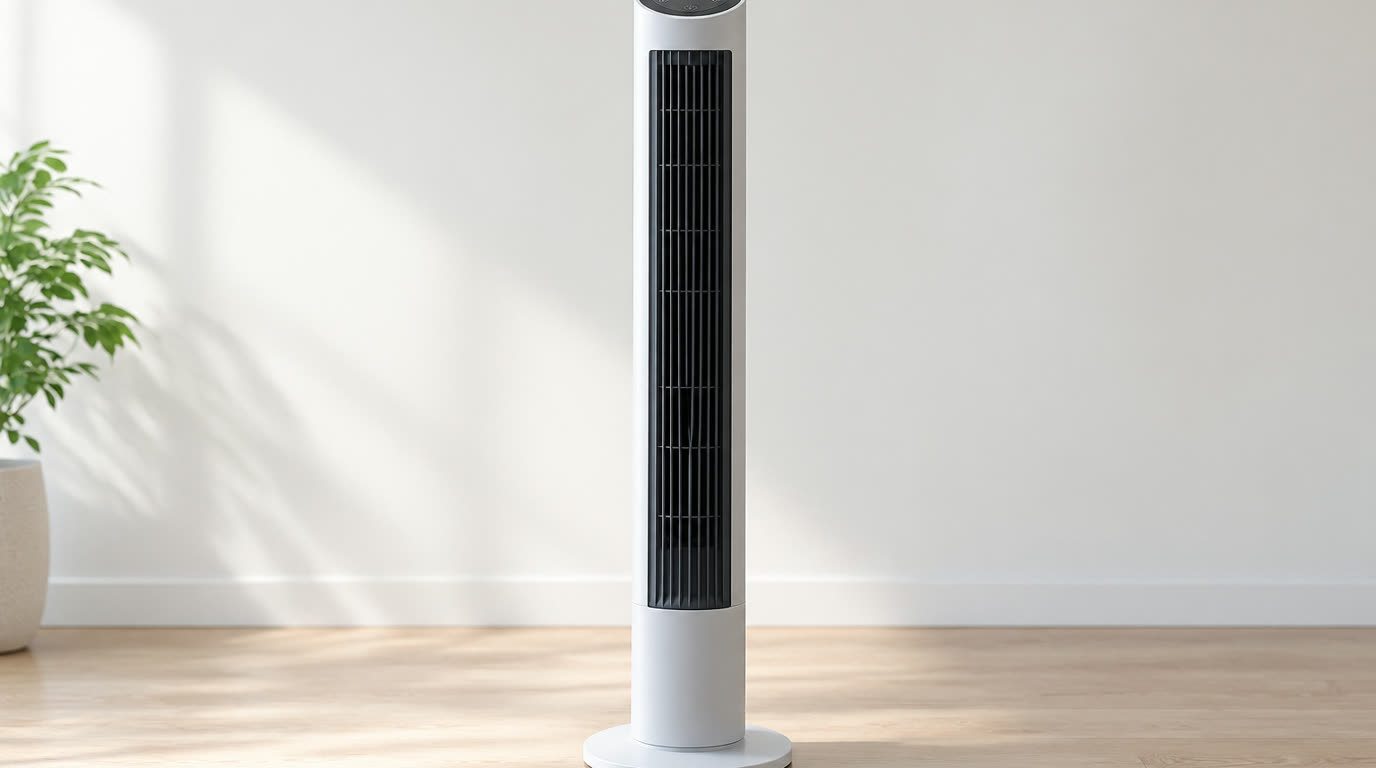
Spend this, not more: The honest spend tier in this category is what the noise figure costs. Desk-grade tower fans run from $49.99 at the maker’s store; the full-height household tier is $79.99 to $159.99 at Dreo and $99.99 to $129.99 at Levoit; the outdoor-rated wind tunnel is the $159.99 top of the maker’s range. What a quiet fan buys is none of the sale tiers and none of the plans: it is the maker’s published noise figure, and the picks are ordered by exactly that.
Quick answer:
- Levoit Windi Lift Smart Tower Fan ($99.99): The maker’s page quotes a noise figure as low as 21 dB, with an adjustable height column and five speeds, smart-app controlled.
- Levoit Windi Mini Pro Portable Desk Tower Fan ($99.99): The quiet desk tower with a 20 dB maker-quoted noise figure and five speeds, sized for a bedside table.
- Dreo Tower Fan 117S ($79.99): The lowest-price full-height pick in the selection, 4 quiet-manuscript speeds and a maker-quoted dB band.
- Dreo TurboPoly Fan 517S ($139.99): A 12-speed tower with a maker-quoted wind throw to 100 feet and the best oscillation span on the page.
- Levoit Classic 42-Inch Smart Tower Fan ($129.99): A 12-speed full-height tower with a maker-quoted 25 dB low-end noise figure and smart-app control.
How much should you spend? A tower fan is a spend you make once, and the spread here is maker-paper. The Levoit desk tier opens at $49.99, the smart column with the adjustable-height column at $99.99, and the classic full-height pair at $129.99. Dreo’s tier runs $79.99 for the 117S and $139.99 to $159.99 for the 12-speed TurboPoly models. What the noise figure buys at each price is a quiet mode rather than a whisper mode, and every maker here stops short of a counter claim: the dB number on the page is what the page publishes, not what a review heard. Rule out the plan-first layouts: no pick here quotes a monthly fee, and the recurring cost is an electricity cycle rather than a subscription.
First: Answer These 3 Questions
- What does a quiet tower fan actually promise? It promises a noise figure the maker quotes on the page, and the numbers differ by more than you expect. Levoit quotes a 21 dB low end on its Windi Lift and a 20 dB figure on the desk mini; its classic 42-inch marks a 25 dB figure. Dreo’s pages carry dB bands with majors quoted around 20 to 37 and 19 on its TurboPoly line. A tower fan whose maker never quotes noise is asking you to trust a rating rather than read it, which is why each pick here publishes one.
- Are 12 speeds marketing or useful? Both, and the honest answer is what the top speeds are for. Dreo’s TurboPoly line quotes 12 speeds, and the geometry is the reason: a narrow number of quiet settings with a wide range to go loud over a hot afternoon. A fan with four speeds, like the maker’s 117S, is a pick for a bedroom with only two features the user ever uses. The speed count is not the pitch: the speeds that matter are a low quiet number and a high airflow figure, and both the quiet and the loud tier quote them.
- How does a desktop tower differ from a floor one? It does not, much: the desk tier is a smaller column with the same airflow story. Levoit’s Windi Mini Pro at $99.99 quotes a 20 dB figure and five speeds on the maker’s page, the exact shape of a bedside fan rather than a corner. The floor tier runs $79.99 to $159.99 with speeds from four to twelve, and its pitch is the whole-room one. The honest difference is the area of the room each covers and the height of the column the air travels at.
- What does an outdoor tower fan need? It needs an outdoor rating, and only one pick here quotes that story: Dreo’s outdoor 711S at $159.99, a page-titled outdoor tower fan with a 33 ft/s wind speed and a 42-foot range. An indoor tower fan is an indoor device at an indoor rating, and spending on an outdoor model for an indoor room is a purchase you do not need to make. The maker’s own page is the honest check for what the rating covers.
- Do smart-app features matter for a fan? For a bedroom and a night shift, on a schedule, they do, and the maker pages differ on what apps they integrate. Levoit’s Windi Lift and Classic tier are smart-app controlled, and the maker’s page quotes the schedule and the timer on the app. Dreo quotes its smart tiers separately on the model pages, so the honest check is the maker’s own page rather than a general smart-home claim. A fan that keeps its quiet number and skips the app is a working product; the app features are a convenience offer makers quote, not a ticket to keeping the fan quiet.
5 Checks Before You Buy
| Check | Target | Plain English |
|---|---|---|
| A maker-quoted dB figure | The noise number on the page | Levoit quotes 21 dB on the Windi Lift and 25 dB on the classic 42-inch; Dreo’s pages carry dB bands. A fan without a quoted figure is a rating you cannot compare. |
| Speed count | Four to twelve settings | Dreo’s TurboPoly line quotes 12 speeds; the 117S quotes four. The speeds that matter are a low-quiet setting and a wide loud end. |
| Airflow reach | Feet and ft/s, quoted | The Dreo outdoor 711S quotes a 33 ft/s wind and a 42-foot range; the 517S quotes a 100-foot throw. Reach is the number behind the room size. |
| Indoor or outdoor rated | Only the 711S is page-titled outdoor | An indoor rating is what a bedroom needs; an outdoor tower fan is a bigger purchase for a bigger environment. |
| Height and footprint | What the room actually fits | The Levoit Windi Lift adjusts its height; the classic tiers are fixed at 42 and 36 inches; the desk Mini runs the bedside. |
| A dollar figure on the maker’s own page | Quotable, honest | Every price here is a figure the maker publishes: $49.99 to $159.99 across the picks, and none of them quotes a monthly plan. |
8 Picks (By Noise dB, Speeds & Airflow Reach)
Levoit Windi Lift Smart Tower Fan – Best Quiet Bedroom Tower
Price: $99.99 on the maker’s store, in stock.
Why: It is the maker’s smart tower fan with the quietest published noise figure of the full-height picks: the maker’s page quotes a 21 dB low end, an adjustable-height column and five speed settings on the app. For a bedroom, a quiet figure at the low end of the band plus a height that aims the airflow over the bed, rather than at it, is the full shape of the pitch.
Honest take: The 21 dB figure is the maker’s low-end quote, and the reach and loud end are on the same page rather than a review. The smart-app features (schedule, timer) are maker-app features, and the speed count is five rather than the 12-speed Dreo tier. Downside: The loud tier tops out at five speeds rather than the 12-speed Dreo class, and the Levoit brand’s quiet tier at $99.99 is the mid-price entry on the page.
Dreo TurboPoly Fan 517S – Best 12-Speed Tower
Price: $139.99 on the maker’s store, in stock.
Why: It is the Dreo tier whose page quotes the fullest walking spread: 12 speed settings and a maker-quoted wind throw of 100 feet, with the quiet tier on the same page listing dB figures as low as the high-teens. The 12-speed layout is a fan for a whole room across a day, and the airflow figure is the reach quoted rather than a review claim.
Honest take: The 100-foot figure is the maker’s throw quote at the loud end, and the quiet tier is a dB band quoted on the maker page rather than a separate review. The 517S is the mid-tier of the TurboPoly line at $139.99. Downside: It is the second-most expensive fan on the page, and the maker’s outdoor-rated tier at the same $159.99 price is the pick if the wall is outside.
Dreo Tower Fan 117S – Best Budget Full-Height Tower
Price: $79.99 on the maker’s store, in stock.
Why: It is the cheapest full-height tower in the selection: the maker’s own store prices it at $79.99, and its page quotes a dB band with a low-in-the-20s quiet figure and four speed settings. For a household budget tier, that is the shape of an honest tower fan: a maker-quoted quiet number, a real speed range, and the lowest price in the class.
Honest take: The speed count is four rather than the 12-speed TurboPoly class, and the dB quotes are the maker’s figures rather than an independent review. The pick is the budget tier of the Dreo line by design. Downside: Four speeds covers the mild bedroom and not the loud July tier, and the maker’s 12-speed line pays for the extra settings.
Levoit Classic 42-Inch Smart Tower Fan – Best Full-Height Smart Tower
Price: $129.99 on the maker’s store, in stock.
Why: It is the maker’s full-height smart tower at $129.99, and the page quotes 12 speed settings, a 25 dB maker-quoted quiet figure, and an airflow footprint the maker marks at 26 feet. The smart-app control and timer features are the maker’s own pitch, and the quiet number is on the page rather than on a review.
Honest take: The 42-inch is a same-family tier beside its 36-inch sibling at the same $129.99 price, so the comparison is the height column and the airflow figure rather than a feature gap. Downside: It is tied for the highest Levoit price on the page, and the maker’s 25 dB low quote is a resident-noise figure rather than the office tier’s 20-21 dB.
Levoit VORTEXAIR Classic 36-Inch Smart Tower Fan – Best Mid-Height Smart Tower
Price: $129.99 on the maker’s store, in stock.
Why: It is the 36-inch classic tier of the same maker and the same price: the page quotes a 25 dB maker figure and a smart-app control tier. For a room where the 42-inch column is too tall or the desk tower is too small, this is the mid-height entry with the maker’s quoted noise figure and the app features of the family.
Honest take: The 25 dB quote is the maker’s own figure on the product page, and the VORTEXAIR line’s airflow reach differs from the 42-inch sibling’s. The maker’s page is the source of both figures. Downside: It is the same $129.99 price as the 42-inch tier with a shorter column, so the honest answer is the room height decision rather than a feature upgrade.
Levoit Windi Mini Pro Portable Desk Tower Fan – Best Quiet Desk Tower
Price: $99.99 on the maker’s store, in stock.
Why: It is the quietest desk tower on the page with a maker-quoted 20 dB figure and five speeds on the app. A bedside table and a small desk is the honest room for it, and at $99.99 the smart-app features travel with the quiet pitch. The Windi Mini at $49.99 below it is the same shape with an unmattered quiet quote.
Honest take: The 20 dB figure is the maker’s page quote, and a desk tier’s airflow is a column rather than a whole-room story. The pick is the desk price tier of the maker’s line by design. Downside: It is $99.99 for a desk unit, which is the same price as the full-height Windi Lift, so the honest comparison is a column-and-reach decision rather than a noise one.
Dreo Outdoor Tower Fan 711S – Best Outdoor-Rated Tower
Price: $159.99 on the maker’s store, in stock.
Why: Dreo’s own page titles this one as an outdoor tower fan, with a maker-quoted wind speed of 33 ft/s and a 42-foot reach, over 12 speed settings. An indoor tower is a different rating, and an outdoor room is the one environment where the reach and the wind-speed figure decide the pick.
Honest take: The 33 ft/s and 42-foot figures are the maker’s page quotes for an outdoor-rated build, and the pick is the only outdoor title in the selection. Indoor walls are the cheaper 117S and 517S tiers’ business. Downside: It is an outdoor-purpose purchase: an indoor room gains nothing over the 12-speed TurboPoly tier at the same $159.99 price.
Levoit Windi Mini Portable Desk Tower Fan – Cheapest Quiet Desk
Price: $49.99 on the maker’s store, in stock.
Why: It is the cheapest tower in the selection: Levoit’s own desk tower at $49.99, in the maker’s Windi family with the personal-fan pitch the maker quotes for desk and bedside use. The mini tier has the quiet figure of its family and a one-time price that leaves the whole purchase statement simple.
Honest take: It is the personal tier of the Windi family rather than the Pro model above it, and its page is a personal-fan pitch rather than a whole-room one. The maker quotes its noise figure on the page. Downside: It is a personal-size tower: a whole room is the business of the Windi Lift above it, and its airflow reach is the shortest in the selection.
One-Line Decision Table
| Your situation | Pick this |
|---|---|
| You want the quietest tower for a bedroom | The Levoit Windi Lift at $99.99, whose maker page quotes the 21 dB low figure and adjusts its column height to aim over the bed rather than at it. |
| You want the most speed settings at an honest price | The Dreo TurboPoly Fan 517S at $139.99 with 12 speeds and a maker-quoted 100-foot throw, or the Levoit Classic 42-inch at $129.99 with 12 speeds and a 25 dB low figure. |
| Your budget decides | The Levoit Windi Mini at $49.99 for a desk, or the Dreo Tower Fan 117S at $79.99 for a full-height tower. Both are maker-quoted quiet tiers and the entry prices of their shapes. |
| The wall is outside | The Dreo Outdoor Tower Fan 711S at $159.99, the only outdoor-rated tower in the selection, with a 33 ft/s wind and a 42-foot reach. |
| You want a bedside or desk unit | The Levoit Windi Mini Pro at $99.99 with its 20 dB maker quote, or the $49.99 Mini below it for the personal tier. |
| You want app control without a hub | The Levoit smart tiers (Windi Lift $99.99, Classic 42-inch and 36-inch at $129.99) quote the maker’s smart-app features on their own pages, and the noise figures sit on the same pages. |
Running Costs: What You Pay After You Buy
The purchase price is only part of the story. Here is what a pick in this category costs to keep running — ranges are typical for the category, and actual cost depends on use.
| Item | What it is | How often | Typical cost |
|---|---|---|---|
| The fan | The one-time price | Once | $49.99 to $159.99 across the eight picks, from the maker’s own store |
| Electricity | The recurring cost | Per season | A tower fan is a low-wattage appliance; the maker pages quote the wattage on spec |
| A replacement filter | Not a cost in this category | No | A tower fan has no filter; the maker’s air-purifier line is the one with cartridge costs |
| Outdoor rating | Only the outdoor pick carries it | Once, more than indoor tiers | The Dreo 711S at $159.99 is the outdoor-rated build |
| A smart-app upgrade | A maker feature rather than a plan | No | The Levoit smart tiers quote app control on their pages rather than as a subscription |
| Space | The footprint you live with | Every day | A 42-inch column vs a desk unit is a room decision, not a price one |
Skip It If… (When Buying Nothing Is the Right Call)
This is the section most buying guides leave out. If any of these describe you, the honest advice is to keep your money.
- You need a fan for a whole outdoor patio. The indoor tiers of this page do not carry an outdoor rating, and the Dreo 711S is the outdoor pick.
- You want a whisper at a loud tier. The maker-quoted dB figures sit at the quiet end of each page’s band, and a fan’s loud tier is where the maker’s band hits its top.
- You expect a 12-speed fan to be quieter at the same price. More speeds is a wider range, and the quiet figure is on the page rather than in the speed count.
- You expect a desk tower to cover a whole room. The Mini tier is a personal unit, and the room is the full-height tiers’ business.
- You want a fan whose noise is an independent review claim. Every dB figure on this page is a maker quote, and the honest framing is the maker’s own number rather than an independent one.
- You are judging a fan with no published noise figure at all. That is why the ranking carries only models the maker quotes in dB.
FAQ
What is a quiet tower fan in decibels? It is a tower fan whose maker publishes their own low-end noise figure. The clearest published figures in this selection are Levoit’s: 21 dB on the Windi Lift smart tower, 20 dB on the Windi Mini Pro desk unit, and 25 dB on the classic 42-inch. Dreo’s pages quote dB bands across their 117S and TurboPoly tiers. A quiet tower is one whose maker puts a number on the page, because a fan that never quotes noise is asking for a trust rather than giving a figure you can compare.
Are maker-quoted dB figures trustworthy? They are the manufacturer’s own figures, and the honest framing is exactly that. Every noise number on this page is a figure that the maker’s own product page publishes, quoted with a quiet end and a loud end rather than as an independent review. Levoit quotes 21 and 25 dB on its towers on their own pages. Dreo’s pages carry dB bands rather than single figures. The DB figure is a specification you hold against the maker, not against a lab, so treat it as the published claim the maker puts its name to.
How many speeds should a tower fan have? Anywhere from four to twelve, and they solve different days. Dreo’s budget 117S quotes four speed settings at $79.99, and its TurboPoly tiers quote twelve speeds at $139.99 to $159.99. Levoit’s Windi family quotes five speeds on the Lift and the Mini Pro, and its classic 42-inch quotes twelve. A fan whose speeds you use are the low quiet tier and the loud afternoon tier; the middle numbers are the marketing band between them. The pitch worth paying for is a low quiet figure at the low end and wide airflow at the top.
What does airflow reach mean on a tower fan? It is how far the air travels, and only some of the picks on this page publish a figure. Dreo’s outdoor 711S quotes 33 ft/s wind speed and a 42-foot reach, and the TurboPoly 517S quotes a 100-foot throw at its top end; Levoit’s 42-inch quotes a 26-foot footprint figure. Reach is the number behind the room: a 26-foot figure covers a bedroom to the far wall, a 42-foot reach covers a driveway, and a personal tower’s quote is a bed, not a room.
Is an outdoor tower fan different indoors? It is rated differently, and only one pick here is outdoor-titled. Dreo’s 711S at $159.99 is the maker’s own outdoor page: the title says outdoor, and the quoted reach figures (33 ft/s, 42 feet) are the numbers of a bigger area. Inside a house, an indoor-rated fan at the same price covers the same shape with the same speeds and costs the same $159.99 on the TurboPoly tier. The pitch is the rating and the environment, and the honest answer is what the maker’s page titles.
Tower fans vs a standing fan: which is quieter? The honest answer is that the shape is not the deciding figure, and the dB is. A tower’s long vertical fan and a standing circulator differ in the airflow shape they push, and the quiet figure is the maker’s own quote rather than the shape. Levoit’s own catalog has both shapes in the family, and its Windi Lift tower quotes 21 dB while its pedestal circulator sits at $89.99 on the same maker’s list. The recording that matters is the dB quote on the page rather than the shape of the product.
Do tower fans need much maintenance? Much less than the category next door. A tower fan has no filter to replace and no cartridge to buy; the maker’s serial pages quote cleaning instructions for the grille and the motor slot, and the air-purifier tier in the same maker’s catalog is the one with a replacement-filter price ($62.99 in Levoit’s catalog). A tower fan’s recurring cost is electricity, and the maintenance is a grille wipe rather than a cartridge plan.
Do smart-app features make a fan quieter? No, the app is a convenience feature and the noise figure is on the wood of the maker’s page. Levoit’s smart tiers (the Windi Lift, the Classic 42-inch and 36-inch) quote app control, schedules and timers as maker features, and their dB quotes sit on the same pages: 21 dB on the Lift and 25 dB on the classics. The app buys scheduling and off-switches from another room, and it prices in at no monthly fee on the maker’s own pitch.
Real Pitfalls to Avoid
- Assuming more speeds equal better quiet. Speed count is a range, the quiet figure is a dB quote, and the maker’s page is the source of both.
- Buying the outdoor tier for an indoor room. The rating is the Dreo 711S’s own pitch, and an indoor wall gains nothing from it.
- Comparing a maker-quoted dB figure with a review quote. Every figure on this page is a maker number, and the honest framing is the same source across picks.
- Judging a desk tower against a floor tower. The desk unit is a personal shape and the reach figure tells the truth about the room.
- Expecting a 25 dB quote at every maker. Levoit publishes figures at 20, 21 and 25; Dreo quotes bands. A maker that publishes neither is a rating you cannot compare.
- Buying on the tallest column rather than the reach. The 42-inch column and the 26-foot footprint travel together on the maker’s page, and the room decides which column works.
Going deeper: A fan is the quiet end of a home comfort decision, and the wet end and the warm end live on the same page of tools. Our basement dehumidifier guide and the ALCI and GFCI heater guide hold the same maker-quoted rule, and the ranking method behind every category is written up in how we rank products.
Update note: refreshed quarterly. Prices checked Sep 2026 – verify at checkout. Rankings based on published manufacturer specifications (noise dB, speeds, oscillation, airflow), vendor prices on official pages, not paid placement.