
Disclosure: Buytoplab is reader-supported. If you buy through links on this page we may earn a small commission at no extra cost to you. We never accept payment for a ranking or a review, and we publish the downsides as plainly as the upsides. How we rank products.
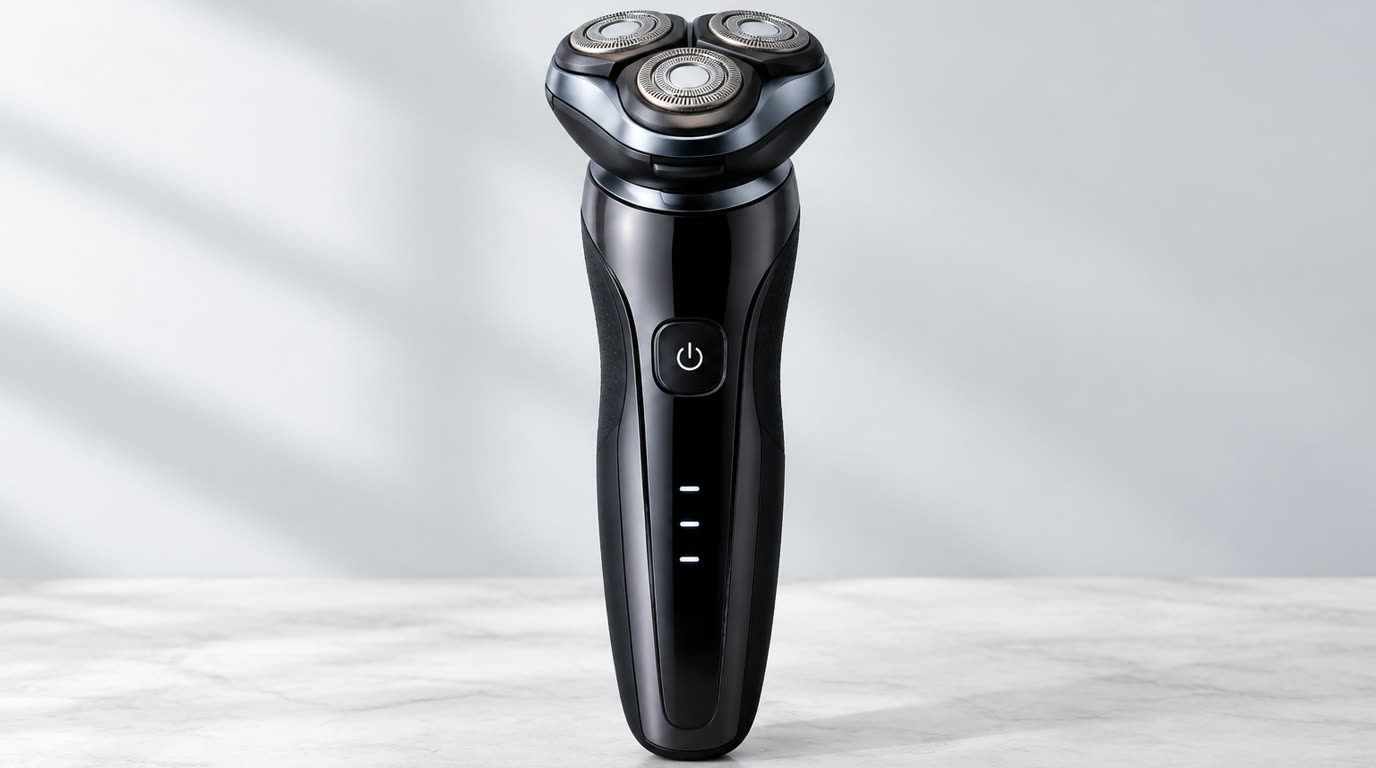
Spend this, not more: $60-180 is the honest window for a shaver built for sensitive skin in 2026. That range covers a foil or hybrid head, a sensitivity or low-sensitivity mode, and a wet-and-dry body you can use with shaving cream. Under $60 the sensitive-skin mode usually is not there, and above $180 you are paying for a rotating head or a skin sensor that most faces do not need.
Quick answer:
- Best overall: Braun Series 9 Pro (~$250) – the AutoSense technology reduces power when it senses more drag, which is exactly the mechanism that stops razor burn on a sensitive face
- Best value: Braun Series 5 (~$100) – a genuinely low-sensitivity mode plus a forgiving foil head, which is the cheapest way to get the anti-pull behaviour that causes irritation
- Best for sensitive skin specifically: Philips Series 5000 (~$150) – a sensitive-skin mode, a rounded profile that follows facial contours, and a self-sharpening blade set that stays kind over time
- Best for daily shaving: Panasonic Arc5 (~$130) – the wet-and-dry head and adjustable comb let you set the hair length first and take a light pass, which cuts passes and therefore irritation
How much should you spend? The reason to spend over $60 on a sensitive-skin shaver is the sensitivity mode and the motor control behind it, not blade sharpness. A $40 rotary can be perfectly sharp and still cause irritation, because irritation comes from dragging the head across skin that has not been properly prepared. $60-180 is where you get adjustable cutting distance, a low-power mode, and a wet-shave option that lets you use a cream barrier.
First: Answer These 3 Questions
- Why does my electric shaver cause razor burn? Almost always pressure and passes rather than the machine. You are pressing the head down, going over the same area repeatedly, and shaving dry, and each of those increases friction on the skin. Let the machine do the work, use a sensitive-skin or low-power mode, and shave onto a prepped face with a proper technique.
- Are foil shavers gentler than rotary shavers? Generally yes on sensitive skin, and the reason is geometry. A foil head stays flat against the skin and cuts hairs as they enter the foil, while a rotary head has a circular cutting surface that pulls the skin slightly taut between passing over it and cutting. Foil is the usual recommendation for facial skin and for a close shave without irritation.
- Should I shave wet or dry for sensitive skin? Wet, and the machine has to support it. Shaving cream reduces friction between the head and the skin, which is the mechanism behind most irritation, and most models rated for wet shaving also rinse the head under the tap after each pass. A shaver with no wet-rating forces you to shave dry, which is the harder case for sensitive skin.
5 Checks Before You Buy
| Check | Target | Plain English |
|---|---|---|
| Sensitive-skin mode | A documented low-power setting | A low-power setting reduces how hard the head is pulled against the skin, which is the direct cause of the tug that leads to irritation. The setting has to be a real manufacturer feature, because a shaver without it has no way to make a heavy beard easier. |
| Wet and dry rated | Usable with gel or cream | Wet shaving is the single most effective change for irritation-prone skin, because the gel or cream is a friction barrier. A dry-only shaver forces the friction problem back onto the skin, and the inability to rinse the head mid-shave makes it worse. |
| Head flexibility and contouring | A head that pivots on a rounded face | A flat head requires you to press harder on the jaw and neck, and pressure is what produces pull. A pivoting head on a curved face is what lets the machine run without you leaning on it. |
| Cutting element longevity | Self-sharpening or replaceable head | A dull head drags, and a dragging head is the mechanism that turns a good shaver into a burning one. Replaceable cartridges or self-sharpening blades are what keep a $120 machine behaving like a new one after a year of daily use. |
| Comb or guard adjustability | Multiple length settings or none | For daily shaving, a length setting means you take one pass at hair length instead of going over the same spot repeatedly. That is a reduction in friction events, and it is why adjustable heads show up consistently in the guides for sensitive skin. |
2026 Top Picks (By Specs, Owner Reports & Price, Not Paid Placement)
Braun Series 9 Pro – Best Overall
Price: ~$250
Why: The AutoSense system reads how much drag the head is meeting and backs the power off, which is precisely the mechanism that prevents the pulling that causes razor burn, and the five-head system means one pass is usually enough on most of the face.
Honest take: At $250 this is the most expensive in the group, and the rotating head requires a case rather than a stand, so it is less convenient to leave on a counter. The 5-in-1 SmartCare Center is in the box, and it is also the part most owners stop using after the first month. Downside: The premium is for sensing and the head set, and a daily shaver with light stubble is paying for capability it will not use.
Where to buy: Braun Series 9 Pro 9477cc – official page
Braun Series 5 – Best Value
Price: ~$100
Why: It has a genuine low-sensitivity mode plus a forgiving foil head, which is the cheapest route to the reduced-pull behaviour that causes irritation, and owner reports on this generation consistently note that it handles a sensitive face without adjustments.
Honest take: The sensor logic is simpler than the Series 7, so on a heavy day it does not adapt the way the more expensive model does, and the plastic body shows wear sooner. Downside: A narrower head means more passes on the jaw than a wider head would need, and the replacement heads are among the more expensive consumables in the category.
Where to buy: Braun Series 5 – official electric shaver range
Philips Series 5000 – Best for Sensitive Skin
Price: ~$150
Why: A documented sensitive-skin mode, a rounded profile that follows the jaw and neck without pressing, and a self-sharpening blade set, which together address the three causes of irritation rather than only the motor.
Honest take: It sits in the awkward middle where it costs more than the Series 5 and has less sensing than the Series 7, so the case for it is specifically a sensitive face rather than value. Downside: The head is not as flexible as the premium foil heads, so very uneven growth takes more care, and the wet-and-dry sealing is good but not fully sealed in the shower.
Where to buy: Philips Norelco Series 5000 S5880/81 – official page
Panasonic Arc5 – Best for Daily Shaving
Price: ~$130
Why: A wet-and-dry head and an adjustable comb let you set hair length first and take one light pass, which reduces passes and therefore reduces the friction events that cause irritation. The 5-level comb is unusually fine at the low end.
Honest take: The comb means the head sits slightly further from the skin, so the result is a close everyday shave rather than a perfectly smooth one, and that is the intended trade. Downside: Cleaning between passes under the tap is the routine that makes it work, and skipping it is the fastest route to the tugging it is meant to avoid.
Where to buy: Panasonic Arc5 ES-LV65-S – official page
Philips Norelco 9800 S9987/85 – Best if Your Beard Is Coarse
Price: Philips lists this at the top of its shaver range. Check the manufacturer’s page for the live figure.
Why: It is the one rotary in this list, and that is not a preference — it is a different mechanism. The Lift & Cut system is designed to lift a hair out of the skin before the blade meets it, and Philips states the blades cut without touching skin. Dual SteelPrecision blades are listed at up to 150,000 cutting actions per minute, the highest published figure of the eight here. For a beard that is coarse or grows back unevenly, a rotary head captures hair growing in any direction, which is the failure case that makes sensitive skin hurt on a foil: you push harder, then you get a raw patch.
Honest take: The Pressure Guard sensor reads how hard you are pressing and shows you when it is too much, which is a genuinely useful behaviour change for someone who shaves the same spot repeatedly. SenseIQ also reads hair density and adjusts power. Philips also lists an integrated pop-up trimmer for edges and a Quick Clean Pod cartridge in the box, plus a 60-minute runtime and a 5-minute quick charge.
Downside: This is the most expensive tier in the group and the sensor suite only pays off if you actually change pressure based on what it tells you. A 2-year head replacement interval (Philips lists SH91) is the cheapest long-run number of the premium models here, but the entry price is the highest. If your beard is normal-to-medium, this is capability you will not use and the Series 5000 below does the same job for a fraction of the money.
Where to buy: Philips Norelco 9800 S9987/85 – official page
Panasonic Arc6 ES-LS9A-K – Best for Thick, Flat-Lying Stubble
Price: ~$400 (Panasonic lists $399.99 on a sale price; confirm the current figure on their page).
Why: Six blades, and they are not six of the same. Panasonic’s published breakdown is two finish blades that cut at the base, two lift blades with reverse-tapered edges for flat-lying hair, and two titanium-coated thick-stubble blades. Those last two exist specifically to scoop up long hairs lying flat against the jaw and neck, which is the hair type that makes a normal pass drag. The linear motor is listed at 84,000 cross-cutting actions per minute and Panasonic states it holds that speed as the battery drains – they publish that as an irritation control, because a slowing blade set means more passes.
Honest take: The 22-direction Multi-Flex head is the most articulate of the eight here, and Panasonic states it reduces pressure on the skin by 10% against the 5-blade LV97. The beard sensor reads density 220 times per second and adjusts power 14 times per second. Blades and foils are hypoallergenic Japanese stainless steel, forged and nano-sharpened to 30 degrees, and the ES-LS9A-K includes the clean-and-charge station. Wet or dry, and it rinses under running water.
Downside: At roughly four times the price of the mid-tier options, it is only the right buy if you genuinely have heavy stubble. Panasonic also sells this head as ES-LS8A without the cleaning station for less, and the station is the part you can skip if you rinse the head. If your stubble is fine, five blades are enough and you should buy below this.
Where to buy: Panasonic Arc6 ES-LS9A-K – official page
Braun NEVO 11000c – Lowest-Friction Foil of the Group
Price: Braun’s current flagship. Check the manufacturer’s page for the live figure.
Why: If your specific complaint is that every foil catches and drags, the number that matters is friction, not blade count. Braun’s published claim for the NEVO is an ultra-low-friction foil paired with what it calls the first AeroTouch cutting system, with 250 diamond-sharp cutting edges and five shaving elements at 40-degree head adaptation. Braun explicitly compares it on friction against its own Series 9 PRO+ and states it is noticeably lower.
Honest take: This is the most directly on-topic product in the list for reactive skin, because the manufacturer is making a claim about glide rather than about closeness. It adapts automatically to beard density, has a smart display that prompts care actions, and the handle is a stainless-steel unibody rather than plastic. Braun’s sensitive-skin guidance also states the principle the whole foil category rests on: an ultra-thin foil sits between your skin and the blades, so your skin does not make direct contact with the cutting edge.
Downside: Flagship pricing, and the NEVO Care 7-in-1 system it is designed to dock into is a separate purchase – do not assume it is in the box. Two years of warranty plus registration, per Braun. A low-friction foil is the fix for catching and tugging. It is not the fix for ingrown hairs, which is a hair-direction problem and needs a different tool.
Where to buy: Braun NEVO 11000c – official page
Panasonic Arc5 PRO ES-L580WS – Best for a Very Dense Beard Under $300
Price: ~$300 (Panasonic lists $299.99 sale; confirm the current figure).
Why: This is the middle of the range and the one most dense-beard owners should actually buy. Panasonic’s own comparison puts two thick-stubble blades and three thin finishing blades on an angled layout, and states that the diagonal arrangement of the finishing blades captures more hair per pass than a straight line of holes. The flexible 20D head moves in 10 directions with 10-direction floating blades, and the Intelligent+ sensor scans 233 times per second. Made in Japan, wet or dry, with a pop-up trimmer.
Honest take: Compared with the Arc5 above, this is the version to buy if your beard defeats the standard five-blade head; compared with the Arc6, you give up the two extra blade roles and the 22-direction head but keep most of the practical benefit for around $100 less. The ES-L580WS includes the automatic clean-and-charge station; the ES-L550WS does not.
Downside: There is no published price below the Arc5 tier without giving up the thick-stubble blades, so if your budget is under $200 the honest answer is the mid-tier foil, not this.
Where to buy: Panasonic Arc5 PRO ES-L580WS – official page

One-Line Decision Table
| Your situation | Pick this |
|---|---|
| Razor burn most mornings, wants the fix | Braun Series 9 Pro |
| Sensitive skin on a budget | Braun Series 5 |
| Shaves twice a week, not daily | Philips Series 5000 |
| Daily stubble to shave in one pass | Panasonic Arc5 |
| Coarse beard that defeats a foil head | Philips Norelco 9800 |
| Thick stubble lying flat on the jaw | Panasonic Arc6 |
| Catching and tugging is the complaint | Braun NEVO |
| Very dense beard under $300 | Panasonic Arc5 PRO |
Running Costs: What You Pay After You Buy
The purchase price is only part of the story. Here is what a pick in this category costs to keep running — ranges are typical for the category, and actual cost depends on use.
| Item | What it is | How often | Typical cost |
|---|---|---|---|
| Replacement heads | When the blades dull | Every 12-18 months | $25-50 |
| Shaving gel or cream | For wet shaving | Monthly | $6-12 |
| Cleaning solution | If the model has a station | Every 2-3 months | $10-20 |
| Pre-shave oil or balm | On sensitive skin before shaving | Monthly | $8-18 |
| Travel case | For a case-based rotary model | Once every 3-5 years | $15-30 |
Skip It If… (When Buying Nothing Is the Right Call)
This is the section most buying guides leave out. If any of these describe you, the honest advice is to keep your money.
- Your irritation is from a technique problem rather than the machine – pressing the head down and going over the same spot repeatedly causes razor burn on any shaver, and $60 of technique costs nothing.
- You shave less than once a week – a quality foil shaver plus a good blade and a proper prep routine beats a premium sensing model you use twice a month.
- You are expecting zero irritation with no product at all – wet shaving with gel or cream is the actual intervention, and a dry-only shaver rules it out.
- You already own a good shaver with dull heads – replacing the cartridge usually resolves the irritation, and it costs a quarter of a new machine.
What “Multi-Blade” Actually Counts, and What It Doesn’t
Blade count is the least informative number on the box. These counts are real – Braun lists 250 diamond-sharp cutting edges on the NEVO and 40,000 cutting actions per minute on the Series 9 Pro; Philips lists 45 self-sharpening SteelPrecision blades and up to 90,000 cutting actions per minute on the Series 5000 S5880/81; Panasonic lists 84,000 cross-cutting actions per minute on the Arc6. But those numbers count cutting edges inside the head, not the edges that touch your face. In a foil shaver, your skin meets a perforated foil and never reaches the blades – which is the mechanism Braun describes when it says its foils carry 1,064 ergonomically formed holes and that your skin never makes direct contact with the blades.
So more blades buys you one thing that does matter: the same result in fewer passes. Every extra pass over the same spot is another chance to drag, and friction events are the mechanism behind razor burn. Three factors decide gentleness more than the blade count does:
- Foil condition. A dented or torn foil is the most common cause of a suddenly rough shave, and it is invisible until you notice it. This is the one item to replace on schedule rather than when it goes wrong.
- How many directions the head flexes. The published figures are 40 degrees / 10 directions on the Braun Series 9 Pro, 22 independent directions on the Panasonic Arc6, and 360-degree flexing heads on the Philips models. More directions means you can follow the contour without pressing, and pressing is what causes irritation.
- Whether cutting speed holds up as the battery drains. Panasonic states the Arc6 motor maintains its 84,000-per-minute rate through the whole charge specifically to avoid the extra irritation that comes from declining cut speed.
Replacement intervals are published and they differ by model: Philips lists SH71 yearly on the Series 5000 and SH91 every two years on the 9800; Panasonic publishes separate blade-and-foil and outer-foil part numbers per head; Braun’s manual for the 9460cc gives 18 months for the foil and cutter cassette. A 250-edge head that is three years past its replacement interval will lose to a 45-blade head that is new.
Heated Razors and Sensitive Skin: What That Search Term Actually Refers To
People searching for a heated razor for sensitive skin are usually looking for a product that does not exist in the form they assume. The heated razor that is actually sold is the GilletteLabs Heated Razor, and it is a manual cartridge razor, not an electric shaver: a stainless-steel warming bar with four heat sensors, two published heat settings (109°F/43°C and 122°F/50°C), five Gillette blades on a FlexDisc, magnetic charging, and up to six shaves per charge. It accepts only GilletteLabs cartridges.
Now the part that matters for reactive skin. Braun’s own sensitive-skin guidance states plainly that some electric shavers draw heat towards the head, and that this can cause inflammation and irritation. Heat is a known irritant factor, not a comfort upgrade, for skin that already reacts. Warming the skin also relaxes and raises the hair so the blade passes over it with less of a keratosis edge to catch – which is a benefit for comfort and a cost for ingrown-hair risk.
Our take: a heated cartridge razor at $100-plus buys you a warm shave, not a lower-irritation shave. For sensitive skin that reacts to pressure and friction, spending on a sensor that reduces how hard you press is a better bet than spending on warmth. If you are considering it, the honest test is a week with the heated razor and a week with a foil electric shaver on the same skin, not the product page. None of the eight shavers on this page has a heated head, and none of the manufacturer specification pages we checked lists a heating element. If a listing claims otherwise, treat it as a mislisting until the manufacturer page confirms it.
If Your Real Need Includes Body Hair, a Face Shaver Is the Wrong Tool
One of the queries this page currently ranks for is an electric trimmer for body hair, and it deserves a straight answer: a foil face shaver is not the right tool for that job. Face heads are sized and shaped for facial contours, and the reason manufacturers run separate body-groomer lines is that the use case is genuinely different. Panasonic’s own Arc5 and Arc6 pages state the shavers work on legs as well, which is a manufacturer claim that a face head can be used on a larger area – it is not an ergonomic answer for chest, abdomen or groin, and a larger flat area is exactly where you end up pressing harder than the head was designed for.
What exists for the job, from Philips’ published range: the Body Groomer 7000 series (BG7470/50) uses a dual trim-and-shave head with a 2D flexing head, 11 length settings, a foldable back attachment for hard-to-reach areas, and a triple-protect shave system with pearl tips, a hypoallergenic foil and a skin guard. The Bodygroom 7000 BG7030/49 is dual-sided, with a four-direction shaver on one edge and an adjustable 3–11mm comb on the other, 80 minutes of runtime and a one-hour charge.
Our take: smooth shave on the chest, abdomen or groin → buy a body groomer with a foil and a skin guard. Even stubble control at a defined length → buy a trimmer with an adjustable comb, because a foil face head has no length control and will give you either bare skin or a tug. Only use the face shaver below the jaw if you already own one and you want the closest result on a small area such as the neckline. Buying a second device for this is cheaper than the ingrown hairs it prevents.
How to Buy: Where the Money Should and Should Not Go
Buy for the head, not the body. The shaver is the one-time cost. The replacement head is the recurring one, and the published part numbers are where the real spread shows: Philips SH71 (yearly) and SH91 (every two years), Braun’s Pro-series cassette, Panasonic’s separate blade-and-foil and outer-foil parts. Over three years, the head cost on a premium model can approach a third of the purchase price. Check the head price before you check the shaver price – a $180 shaver with a $70 head can cost more over three years than a $250 shaver with a $30 head.
Decide the cleaning station separately. All eight shavers here are waterproof or rinse-clean. The cleaning stations add a recurring cartridge cost and are worth it for one profile only: you shave every day, and you would not rinse the head under a tap every morning. Everyone else should skip the station and take the cheaper model in the range — Panasonic makes this an explicit choice within a single product line, selling the ES-LS9A with the station and the ES-LS8A without it.
The $60–180 versus $400 rule. Spend above $180 only when you have a specific trigger, not for general quality: a beard that defeats a five-blade head, skin that reacts to friction rather than to closeness, or a shaving frequency high enough that a cleaning station pays for itself. Without one of those triggers, the mid tier is the honest buy and the flagship money is optional. This is the same reason the four most expensive machines on this page are framed as narrow answers rather than as general recommendations.
Where to buy it. For a device with a two-year warranty, a replaceable head and published firmware-free accessories, the manufacturer page is the cleanest place to establish the official head part number and the warranty terms for the exact model you are buying – model numbers in this category vary by retailer with cosmetic and bundle differences and the same number may not be the same box. Buy from a retailer when the manufacturer has no stock for your region. Either way, register the product: Braun states registration adds three years on top of the two-year warranty, and Philips states two years plus two years of software updates.
What a “sensitive skin” claim legally has to be. Per the FDA pages in the sources below, personal-care devices are regulated as cosmetics or as medical devices depending on their claims, and the FTC’s advertising guidance sets the substantiation standard for what a seller must be able to prove about a performance claim. That is why this page does not repeat marketing adjectives without attributing them: when we say a manufacturer states something about its own product, that is a published specification, and it is the only class of performance claim we can verify without running the device ourselves.
Sources & Data
This guide uses official specifications, published results from named review bodies and long-term owner reports. Featured sources (verified 2026-09-26):
- Braun Series 9 Pro 9477cc – manufacturer specifications and box contents for the flagship pick
- Braun NEVO 11000c – manufacturer page for the low-friction foil claim and cutting-edge count
- Braun: Electric Shaver for Sensitive Skin – manufacturer guidance on foil design and heat near the shaving head
- Philips Norelco Series 5000 S5880/81 – manufacturer specifications, blade count and head replacement interval
- Philips Norelco 9800 S9987/85 – manufacturer specifications for the rotary pick and SenseIQ sensors
- Philips Norelco Body Groomer 7000 BG7470/50 – manufacturer specifications for the body-grooming comparison
- Philips Norelco Body Groomer range – manufacturer range page listing body-groomer models and comb ranges
- Panasonic Arc5 – manufacturer specifications and current price for the daily pick
- Panasonic Arc5 PRO – manufacturer specifications and current price for the dense-beard pick
- Panasonic Arc6 – manufacturer specifications, blade roles and current price
- Panasonic Arc6 press release – manufacturer statement on blade roles, motor speed and skin-pressure claim
- GilletteLabs Heated Razor – manufacturer page for the heated-razor heat settings and cartridge compatibility
- AAD Hair and Scalp Care – dermatologist guidance on shaving and sensitive skin
- FDA Cosmetics – FDA regulation overview for personal care products
- FDA Medical Devices – classification and safety requirements for grooming devices
- FTC Advertising Guidance – substantiation rules for product claims
Table sizes, wattage and prices change; verify current specs at the manufacturer before you buy.
FAQ
What is the best electric shaver for sensitive skin The Braun Series 9 Pro is the strongest pick because its sensing reduces power when it meets more drag, which directly prevents the pulling that causes razor burn. The Braun Series 5 at $100 is the budget answer, and the Philips Series 5000 is built specifically around a sensitive-skin mode.
Why does my electric shaver irritate my skin The usual causes are pressing the head down, taking repeated passes over the same area, and shaving dry. All three increase friction, and friction is the mechanism behind razor burn. Let the machine do the work, use a low-sensitivity mode, and shave wet with gel or cream.
Are foil shavers better for sensitive skin Usually yes. A foil head sits flat against the skin and cuts hairs as they enter the foil, while a rotary head passes over the skin before cutting, which pulls it slightly. Foil is the common recommendation for a close shave with less irritation.
Should I use shaving cream with an electric shaver Yes, if the model is rated for wet shaving, because the cream is a friction barrier and friction is what causes irritation. Check the rating first, since dry-only models are sealed for electronics and cannot be used with gel.
How often should I replace the head on an electric shaver Roughly every 12-18 months for daily shaving, and sooner if your hair is coarse. A dull head drags rather than cuts, and a dragging head is the most common reason a good shaver starts causing irritation.
Real Pitfalls to Avoid
- Pressing the head down – the most common cause of razor burn on a quality machine, because pressure is what creates the friction the shaver cannot overcome without dragging.
- Shaving the same spot repeatedly – every extra pass is another friction event, and setting a length with a comb or accepting two full passes is the actual fix.
- Skipping the comb and going for a bare shave – a foil head is designed to sit slightly off the skin, and forcing it flat doubles the friction.
- Ignoring dull heads – a cartridge that has lost its edge drags, so the irritation people blame on the brand is usually a consumable that needed replacing.
Going deeper: The method behind these rankings is written up on our how we rank products page. For the wider grooming picture rather than shaving, electric shavers in 2026 covers foil and rotary side by side, and epilators in 2026 covers the hair-removal route that avoids shaving altogether.
Update note: refreshed quarterly. Prices checked Sep 2026 – verify at checkout. Rankings based on published specifications, published review-body scores and long-term owner reports, not paid placement.