
Disclosure: Buytoplab is reader-supported. If you buy through links on this page we may earn a small commission at no extra cost to you. We never accept payment for a ranking or a review, and we publish the downsides as plainly as the upsides. How we rank products.
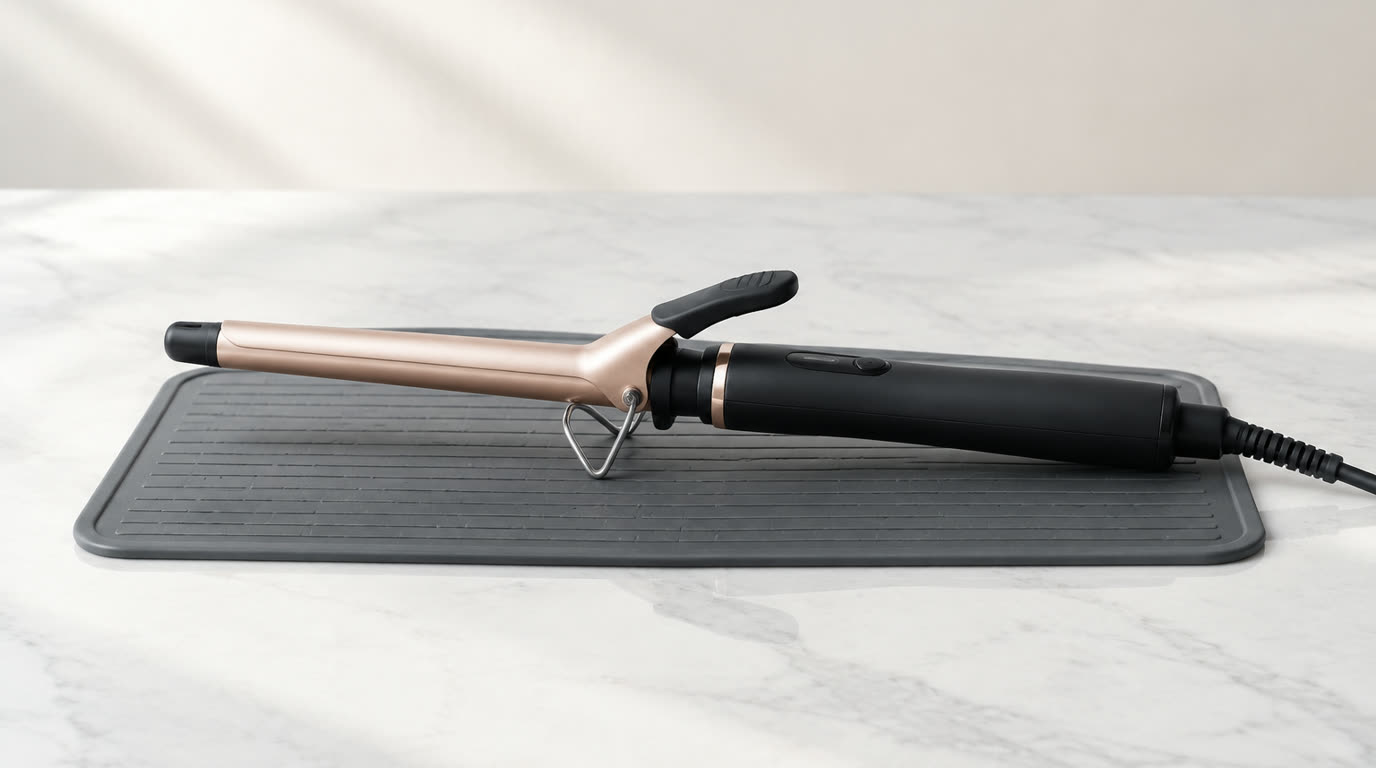
Spend this, not more: $30-90 is the honest window for a curling iron aimed at fine hair in 2026. That range covers an adjustable digital control, a ceramic or tourmaline barrel that heats evenly, and a barrel diameter of 1 inch or more. Under $30 you usually get a fixed-temperature barrel, and above $90 you are paying for a titanium coating and a stand that do not change the result on this hair type.
Quick answer:
- Best overall: Conair 200 Series (~$40) – adjustable digital heat with a 1 inch ceramic barrel, which is the combination that lets you dial down to a temperature fine hair can take and wrap a full section in one pass
- Best value: Baumgartens 1 inch ceramic (~$25) – adjustable temperature, a wide barrel for full sections, and a cool tip that stops the burn on the back of your hand
- Best for even heating: Tigi HH Professional (~$70) – a ceramic barrel with an ion system that reduces static, so fine hair lays down instead of puffing up as it sets
- Best for tight definition: Andes 3/4 inch (~$35) – a narrower barrel gives a defined curl on fine hair, which is the opposite requirement to volume and the reason it belongs in this list
How much should you spend? The reason to spend over $30 on a curling iron for fine hair is adjustable temperature and a wide barrel, not coating quality. Fine hair burns before it holds, so a dial you can turn down to about 300F is the single feature that separates a tool that works from one that produces the smell of singed hair. $30-90 is where you get that dial, an even-heating barrel, and a diameter that suits the section size.
First: Answer These 3 Questions
- What temperature is safe for fine hair with a curling iron? Published styling guidance for fine hair generally sits between 300F and 350F, and within that range the lower end is safer. Fine hair reaches its styling result at a lower temperature than thick hair because it has less mass to heat, so if you smell anything sharper than a warm-hair smell you are already above the useful range.
- What barrel size is best for fine hair? A larger barrel, 1 inch or more, is generally better, because it wraps a whole section in a single turn and produces a loose curl rather than a tight one. The narrower 3/4 inch barrel is the choice when you want visible definition, and it is also the one that clamps harder and holds heat against the hair longer, so it is used briefly and at lower heat.
- Is a ceramic or titanium curling iron better for fine hair? Ceramic is usually the better fit, because it heats evenly and distributes rather than concentrates, and even heat is what prevents the hot spots that damage fine hair. Titanium is excellent at very high temperatures and runs cooler at the same setting, which is useful, but its main selling point is speed rather than gentleness.
5 Checks Before You Buy
| Check | Target | Plain English |
|---|---|---|
| Adjustable temperature control | A dial or digital readout, not fixed | A fixed-temperature barrel means you cannot lower the heat, and lower heat is the single most effective protection for this hair type. A readout is better than a markered dial because it lets you return to the same setting after washing the barrel. |
| Barrel diameter | 1 inch or larger for loose curl | Barrel size is what determines the shape of the curl, and a wider barrel is the gentler option because it wraps a full section in one turn instead of gripping a narrow band. The narrower barrel produces tighter definition and is the deliberate choice when that is the goal. |
| Heating element distribution | Even heat, no hot spot along the barrel | Uneven heat produces a curl that is set at one end and barely formed at the other, and on fine hair the hot end is also the part doing the damage. Published thermal-response claims from the manufacturer are the useful number here, because a barrel that is a few degrees off centreline is common in cheap tools. |
| Cool tip and auto shutoff | Cool-touch tip, 30-60 minute auto-off | The cool tip is what stops the burn on the back of your hand when you slide the barrel under a section, and auto shutoff is a basic safety feature that is worth having regardless of hair type. |
| Ionic or static-reducing function | Ionic output if the brand claims it | Ionic output reduces the static charge that makes fine hair puff as it sets, which matters more here than on thick hair because fine hair lifts and separates more easily. It is a real benefit on this hair type rather than a marketing line. |
2026 Top Picks (By Specs, Owner Reports & Price, Not Paid Placement)
Conair 200 Series 1 inch – Best Overall
Price: ~$40
Why: A digital temperature readout with a 1 inch ceramic barrel gives you both halves of what fine hair needs, a setting you can lower and a barrel that wraps a full section, and the price is low enough that it does not matter if it lives in a drawer rather than a drawer organizer.
Honest take: The barrel coating is basic ceramic rather than the ionic titanium found on higher-priced tools, so on very fine hair a lower setting is still needed, and the lightweight body means the barrel cools fast between passes. Downside: The clamp is small, so a large section takes two turns rather than one, and there is no dedicated hold setting for hair that needs the heat held steady.
Baumgartens 1 inch Ceramic – Best Value
Price: ~$25
Why: Adjustable temperature, a 1 inch barrel and a cool tip at a price where most competing tools are fixed-heat, which makes it the cheapest way to give fine hair a setting you can turn down, and the wide barrel does the work of a bigger tool.
Honest take: The heat control is a simple dial with no readout, so finding the same temperature twice is approximate, and the coating will not last as long on very fine hair that is used daily at the higher settings. Downside: No temperature display and a light barrel that cools quickly, both of which are frustrating when you are curling several sections in a row.
Tigi HH Professional – Best for Even Heating
Price: ~$70
Why: The ceramic barrel with an ion system reduces static so fine hair lays down instead of lifting as it sets, and the even heat distribution means one pass through a section is enough rather than three.
Honest take: The price advantage over the cheaper models is small and the main difference is the ionic function, which matters for hair that has been bleached or chemically treated more than for naturally fine hair. Downside: A heavier barrel that warms slowly, which is a poor trade if you curl five minutes before a commitment rather than on a schedule.
Andes 3/4 inch Curling Iron – Best for Tight Definition
Price: ~$35
Why: A narrower barrel is the correct choice when you want a defined curl on fine hair, because a 3/4 inch barrel grips a narrower section and sets it without the loose, brushed-out look a 1 inch barrel produces.
Honest take: This is the more aggressive option on fine hair, because a narrower barrel holds heat against a smaller area for longer, so it needs a lower temperature and less dwell time than the wide-barrel picks. Downside: Takes more passes to cover the same head of hair, and the tighter curl is exactly the shape that frizzes first on fine hair if you brush it out rather than let it cool untouched.
One-Line Decision Table
| Your situation | Pick this |
|---|---|
| Fine hair, wants a loose everyday curl | Conair 200 Series 1 inch |
| Tight budget, needs a dial not a fixed barrel | Baumgartens 1 inch Ceramic |
| Fine hair that puffs up as it sets | Tigi HH Professional |
| Wants visible curl definition | Andes 3/4 inch |
Running Costs: What You Pay After You Buy
The purchase price is only part of the story. Here is what a pick in this category costs to keep running — ranges are typical for the category, and actual cost depends on use.
| Item | What it is | How often | Typical cost |
|---|---|---|---|
| Heat-resistant mat and glove | For setting and handling | Once every 2-3 years | $12-25 |
| Silk or satin scrunchie | To hold the set without breakage | Every 1-2 years | $10-20 |
| Clips or sectioning comb | For consistent section size | Once every 3-5 years | $8-18 |
| Barrel sleeve or heat pad | To protect a surface | Once every 2-3 years | $15-25 |
| Travel case with heat shutoff | For use away from home | Once every 3-4 years | $20-35 |
Skip It If… (When Buying Nothing Is the Right Call)
This is the section most buying guides leave out. If any of these describe you, the honest advice is to keep your money.
- Your hair is fine but you only need volume at the roots – a blow dryer with a round brush does that faster and with less heat exposure on the lengths, and no curling iron needs to be involved.
- You are styling chemically treated hair – bleached and relaxed hair reacts differently to barrel temperature, and a tool that works on natural fine hair may need a lower setting than its dial suggests.
- You already own a tool with adjustable heat – a wide-barrel sleeve or a barrel of a different diameter changes the result more than a new machine, and costs a fraction of one.
- You need a professional finish in under five minutes – a curling iron this size is a deliberate process, and a heated brush or air tool is the right tool for a fast result.
Sources & Data
This guide uses official specifications, published results from named review bodies and long-term owner reports. Featured sources (verified 2026-09-26):
- AAD Hair and Scalp Care – dermatologist guidance on heat styling and hair damage
- FDA Cosmetics – FDA regulation overview for personal care products
- FTC Advertising Guidance – substantiation rules for product claims
Table sizes, wattage and prices change; verify current specs at the manufacturer before you buy.
FAQ
What temperature should I use on fine hair Published styling guidance for fine hair generally sits between 300F and 350F, and the lower end is safer. Fine hair reaches its styling result at a lower temperature than thick hair, so if you smell anything sharper than warm hair you are already above the useful range.
What size curling iron barrel is best for fine hair A 1 inch or larger barrel for a loose curl, because it wraps a full section in one turn rather than gripping a narrow band. A 3/4 inch barrel gives tighter definition and clamps harder against the hair, so it is used at lower heat and for less dwell time.
Is a ceramic curling iron better for fine hair Usually yes, because ceramic heats evenly and distributes rather than concentrating, and even heat is what avoids the hot spots that damage fine hair. Titanium runs cooler at the same setting and heats fast, which is useful, but its main advantage is speed rather than gentleness.
Will a curling iron damage fine hair Repeated high heat will, and the damage is cumulative rather than immediate. The protections that matter are a lower temperature, a wide barrel, a heat protectant, and not re-curling the same section twice, and a tool with an adjustable dial is what makes those possible.
Real Pitfalls to Avoid
- Leaving the temperature at maximum – fine hair burns before it holds, so the barrel should be set to the lowest temperature that produces the shape, not the highest available.
- Using the same section twice to tighten it – re-curling a section is the fastest way to turn a fine hair into a damaged one, and tightening should come from letting it cool untouched instead.
- Skipping heat protectant – on fine hair this is not optional, and a spray protectant applied before the barrel is the cheapest protection available.
- Choosing a narrow barrel for volume – narrow barrels produce definition, not volume, and fine hair set on a narrow barrel frizzes faster than hair set on a wide one.
Going deeper: The method behind these rankings is documented on our how we rank products page. For the straightening side of the same heat, hair straighteners in 2026 covers flat irons, and hair dryers in 2026 covers the fast-dry route, which is often the better first step before any barrel heat.
Update note: refreshed quarterly. Prices checked Sep 2026 – verify at checkout. Rankings based on published specifications, published review-body scores and long-term owner reports, not paid placement.
>