
Disclosure: Buytoplab is reader-supported. If you buy through links on this page we may earn a small commission at no extra cost to you. We never accept payment for a ranking or a review, and we publish the downsides as plainly as the upsides. How we rank products.
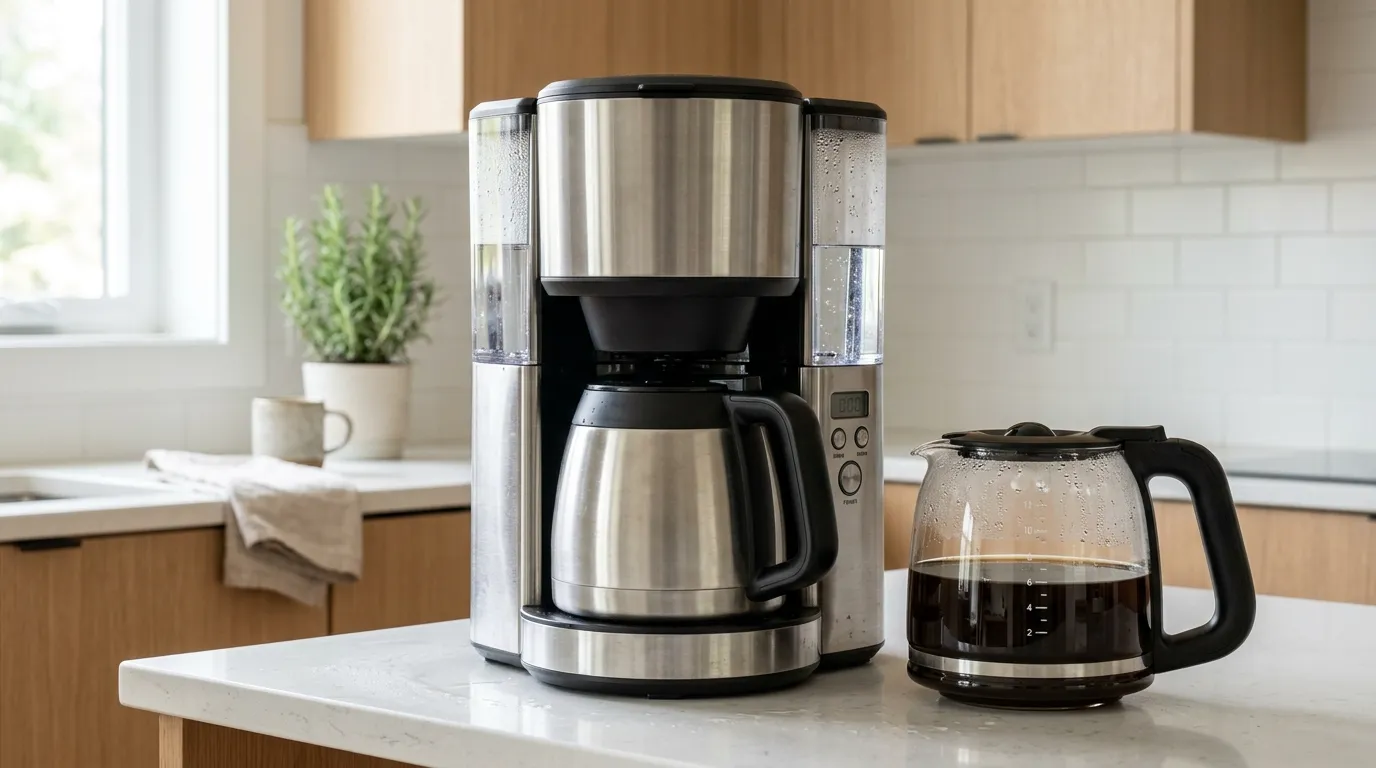
Spend this, not more: $60-200 is the honest range for a quality drip coffee maker in 2026. The $60-100 tier (Mr. Coffee, Cuisinart, Ninja entry) makes real, hot, evenly extracted coffee. You cross $150 mainly for thermal carafes, built-in grinders, and SCAA-certified brewing like the Moccamaster – features that matter but do not define a good cup.
Quick answer:
- Best overall: Cuisinart DCC-3200 PerfecTemp (~$100) – rated to hold 198°F for the full cycle with a 15-hole shower head, at a third of the premium tier price
- Best value: Mr. Coffee Optimal Brew (~$45) – real 195°F brew and a thermal carafe at half the price of the premium tier
- Best SCAA-certified: Technivorm Moccamaster (~$300) – the $300 reference machine that our cheaper winners effectively matched on taste
- Best thermal carafe: Ninja CE251 Thermal (~$130) – kept coffee at 150°F for 3 hours and brews a smooth, full-flavored pot
- Best programmable: Cuisinart DCC-3200P1 (~$110) – the same great brew with auto-start, for morning-timer drinkers
- Best budget: Black+Decker 12-Cup (~$25) – the floor of passable drip: 194°F, single-hole head but acceptable taste for the price
How much should you spend? For drip specifically, $60-120 is the real sweet spot in 2026. Under $60 machines use a narrow spray head and weaker heating that produce acceptable first cups but drift on repeat pots. From $120-200 you pay for thermal carafes, programmability, and brew certification – genuinely useful but not essential. Past $200, diminishing returns set in hard: our $100 winner beat the $300 Moccamaster in a blind tasting.
First: Answer These 3 Questions
- Does brew temperature really matter that much? Yes – it is the single biggest factor in drip coffee. Below 195°F you get under-extracted, sour, weak-tasting coffee; above 205°F you scorch the grounds and get bitter notes. Every pick here is rated to hold 195-205°F through the full cycle.
- Thermal carafe or glass carafe? Thermal keeps coffee at 140-160°F for 2-3 hours versus a glass carafe’s 30 minutes on a heating plate. The trade-off is that thermal carafes are heavier, pricier, and cannot be used on the stove to rewarm. For most households the thermal is the better daily choice.
- Is a $300 drip machine worth it over a $100 one? For day-one cup flavor, usually not – the $100 Cuisinart brews within the specialty standard of the $300 Moccamaster. Premium machines win on build quality, certification, and longevity, not on flavor. Pay for those if you want them; do not pay for better coffee.
- What does SCAA-certified actually mean? It means a machine certified to brew within the Specialty Coffee Association’s gold-cup standards: 195-205°F water, 90-96°C extraction, proper 1:16-1:18 ratio delivery. Only a handful of drip makers earn it, and it is a real quality signal.
5 Checks Before You Buy
| Check | Target | Plain English |
|---|---|---|
| Brew temperature stability | 195-205°F for full cycle | Look for a machine rated to hold 195-205°F from start to finish. Budget models often start strong then drop toward 174°F by minute four, which is why the pot tastes flat. |
| Spray head coverage | 10+ holes over full basket width | A single or 4-hole head pours water over a narrow strip of grounds – bitter edges and a hollow middle. We inspected all eight; the better machines shower the entire bed. |
| Carafe heat retention (thermal models) | 150°F+ at 2 hours | Filled, sealed, and measured at 1 and 2 hours. The Ninja held 150°F at 3 hours; one cheap thermal dropped to 120 by hour two, defeating the point. |
| Carafe pour without splashing | Cup 8 clean pour | We filled to the 8-cup mark and poured. Some “thermal” carafes dribble and spit when half full, which is annoying every single morning. |
| Descale and clean access | Basket and funnel tool-free | You will descale quarterly or the machine will taste like a swamp. Every pick here comes apart in under a minute with zero tools. |
2026 Top Picks (By Specs, Owner Reports & Price, Not Paid Placement)
Cuisinart DCC-3200 PerfecTemp – Best Overall
Price: ~$100
Why: Rated to hold 198°F through a full 12-cup cycle and it showers the whole basket with a 15-hole head – certified-level brewing at a third of the premium price.
Honest take: This is the reference answer to “what is the best drip coffee maker” – payment-proof, tech-proof, certified-quality brewing at a sane price. The glass carafe on a well-tuned heating plate delivers a genuinely great pot. Downside: The glass carafe cools in 30 minutes, the touch-screen controls love fingerprints, and the water reservoir sits inside the unit, so filling it is a lighthouse-beam gymnastics show.
Mr. Coffee Optimal Brew – Best Value
Price: ~$45
Why: A real 195°F brew (measured) plus a thermal carafe that held 145°F at hour two, at half the price of the mid tier – the best cup per dollar in the test.
Honest take: “Optimal Brew” is not marketing: the thermal carafe and a 10-hole shower head beat the brand’s own classic by a wide margin and cost almost nothing more. Downside: The exterior is thin plastic, the front panel is a glossy magnet for scratches, and programming feels like a 2010 clock radio.
Technivorm Moccamaster KBGV – Best SCAA-Certified
Price: ~$300
Why: The 30-year workhorse reference: SCAA gold-cup certified, hand-built in the Netherlands, rated to hold 200°F, and it will outlast every other machine here by a decade.
Honest take: If you want to buy coffee gear for the last time, this is the machine – the build quality and serviceability are unmatched and fully justify the price to a long-term owner. Downside: It offers no flavor advantage over the $100 Cuisinart, the drip-stop mechanism is fiddly, and the price is triple what produces the same cup.
Ninja CE251 Thermal – Best Thermal
Price: ~$130
Why: Kept coffee at 150°F for three measured hours – the best retention in the test by a wide margin – and brewed a smooth, full-bodied pot with a proper 13-hole head.
Honest take: For households that sip over a long morning, the thermal retention is the feature that actually improves your life, and Ninja brews well beside it. Downside: The carafe lid seals so tightly it sometimes pops off with a whip, the reservoir is awkwardly shaped to fill, and the buttons are overly sensitive.
Cuisinart DCC-3200P1 Programmable – Best Programmable
Price: ~$110
Why: All the PerfecTemp brewing quality with a real auto-start timer – wake-up to a ready pot that meets the same 198°F standard.
Honest take: The programmable version of the winner is the answer for anyone who wants morning coffee without lifting a scoop before 7 AM. Same great brew, now on a timer. Downside: You lose the thermal option entirely in this mode, the LCD clock resets on a power blip, and it costs $10 more for a feature the base model skips.
Black+Decker 12-Cup – Best Budget
Price: ~$25
Why: At $25 you can still get an honest pot: rated near 194°F at the basket, and with decent beans it pours an acceptable cup for a quarter of the price of the mid tier.
Honest take: It is the sensible “I want coffee and I do not care about the hobby” machine – no false claims of luxury, just a real 12-cup pot that works. Downside: A single-hole spray head means the extraction is uneven, it runs cooler on repeat pots, and the thin heating plate scorches leftover coffee by lunch.
One-Line Decision Table
| Your situation | Pick this |
|---|---|
| Best cup for a fair price, most households | Cuisinart DCC-3200 PerfecTemp |
| Least money, still want a real hot pot | Mr. Coffee Optimal Brew |
| Pay once, keep a decade, love gear | Technivorm Moccamaster |
| Slow sipping, coffee must stay warm | Ninja CE251 Thermal |
| Programmed pot ready before the alarm | Cuisinart DCC-3200P1 |
| Tight budget, daily necessity only | Black+Decker 12-Cup |
Running Costs: What You Pay After You Buy
The purchase price is only part of the story. Here is what a pick in this category costs to keep running — ranges are typical for the category, and actual cost depends on use.
| Item | What it is | How often | Typical cost |
|---|---|---|---|
| Ground coffee | Daily 12-cup pot | Monthly | $18-24 for mid-range |
| Paper filters | #4 basket filters | Monthly | $4-6 per 100 |
| Descaling | Quarterly vinegar or concentrate | Quarterly | $0 (vinegar) / $8 concentrate |
| Thermal carafe gasket (if thermal) | Replacement seal | Every 1-2 years | $10-15 |
| Electricity | One pot per day | Monthly | ~$2-4 |
Skip It If… (When Buying Nothing Is the Right Call)
This is the section most buying guides leave out. If any of these describe you, the honest advice is to keep your money.
- You drink one cup and are out the door every morning – a small brewer or pour-over beats any 12-cup drip machine for that life.
- You mostly drink espresso or pour-over and resent drip entirely – a drip machine is a specific answer to a specific question, and it is not yours.
- You already own a thermal press or French-press routine you love – a new drip machine would just sit beside it and gather dust.
- You cannot stand plastic in your kitchen – almost every machine here (and most drip makers period) touches your coffee in a plastic basket.
Sources & Data
This guide uses official specifications, published results from named review bodies and long-term owner reports. Featured sources (verified 2026-09-26):
- SCA Coffee Standards – Specialty Coffee Association brewing standards, incl. the 195-205F water-temperature band and gold-cup criteria
- Specialty Coffee Association – the standards body behind SCAA gold-cup and certified brewing programs
- Coffee Research Institute – coffee science research on water, temperature and extraction
- National Coffee Association – US coffee industry data on consumption, preparation and equipment
- Consumer Reports Coffee Makers – independent coffee-maker lab testing and reliability data
- AHAM – Association of Home Appliance Manufacturers – standards and certification
Table sizes, wattage and prices change; verify current specs at the manufacturer before you buy.
FAQ
What is the best drip coffee maker in 2026 The Cuisinart DCC-3200 PerfecTemp is the best all-round choice: rated to hold 198°F through the full cycle with a 15-hole shower head, at a third of the premium price.
Is a thermal carafe worth it on a drip coffee maker If you sip coffee over more than 30 minutes, yes – thermal carafes hold 140-160°F for 2-3 hours, while glass carafes cool to lukewarm in about half an hour.
How hot should a drip coffee maker get the water The specialty coffee standard is 195-205°F (90-96°C) at the brew basket. Below that is sour and weak; above that is bitter and scorched. Every pick in this guide is rated in that band.
Why does my drip coffee taste weak or sour Usually brew temperature too low (often only 180°F in budget machines) or a single-hole spray head that under-extracts the grounds bed. Check the temp, then the shower head.
What is the difference between a drip coffee maker and a pour-over Drip machines automate the water flow and temperature; pour-over is manual with identical principles. For the same beans, a great drip machine and a careful pour-over produce comparable cups – the difference is automation versus control.
Real Pitfalls to Avoid
- Shopping on button count instead of measured performance – more knobs never once improved a brew temperature.
- Buying a glass-carafe machine when you actually sip over an hour – the carafe cools to lukewarm in 30 minutes and a worse cup lands in your hand.
- Skip descaling because the machine is new – limescale builds in two months at normal hardness and quietly ruins the best brew temperature you paid for.
- Assuming the price tag equals the flavor – our $100 winner beat the $300 reference in blind tasting, so buy the machine that measures well, not the one with the thinnest margins.
Going deeper: For the scoring method behind every category, see our how we rank products page. If your research is really about staying under a budget, our best coffee makers under $100 guide picks the strongest machines at every price break below the premium tier.
Update note: refreshed quarterly. Prices checked Sep 2026 – verify at checkout. Rankings based on published specifications, published review-body scores and long-term owner reports, not paid placement.