
Quick answer: size it right or don’t bother
90% of crate problems are sizing problems. A crate that’s too big lets your dog use one corner as a bathroom (defeating house-training). Too small is cruel and causes anxiety. Measure your dog, not your guess, and buy for adult size with a divider for puppies.
Disclosure: Same deal — we earn a commission on qualifying purchases, never from brands, and we publish both the win and the flaw.
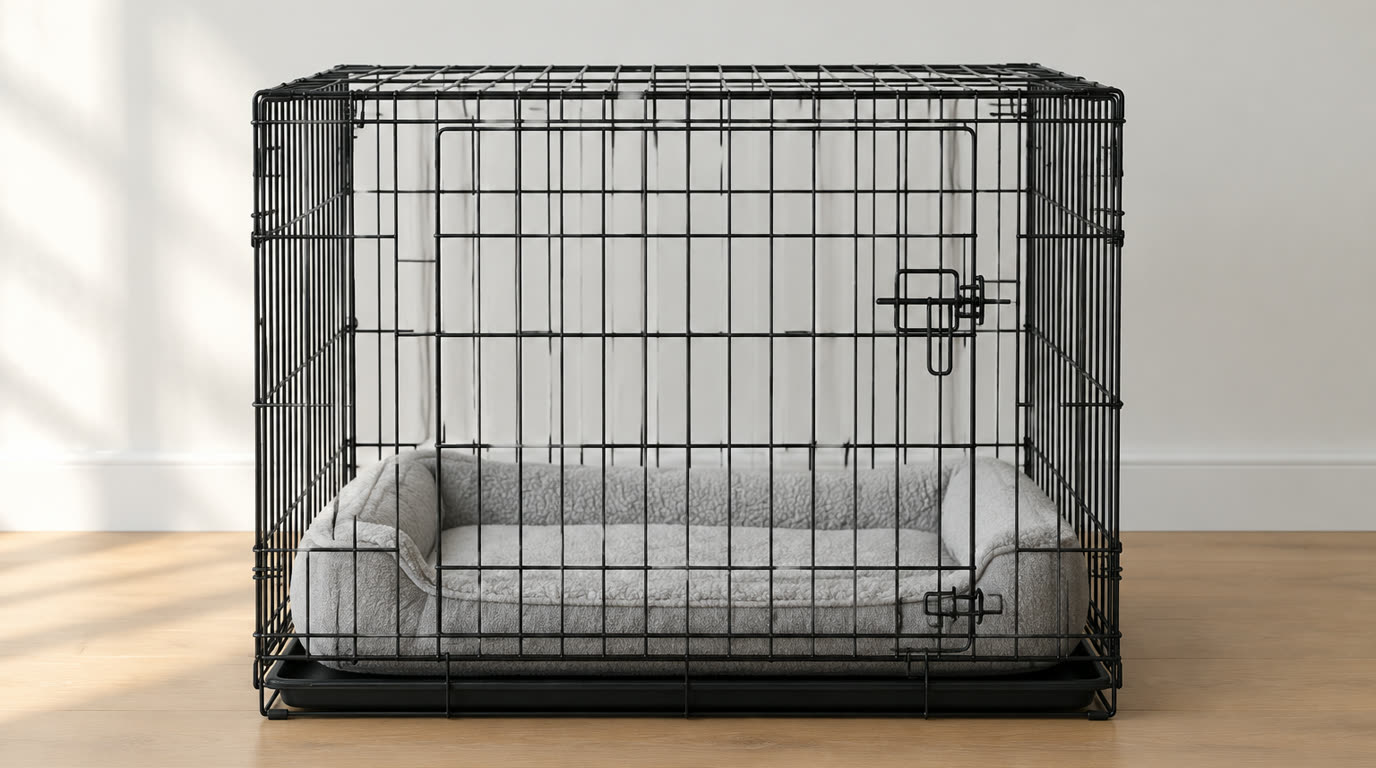
Before you buy: the 4 sizing rules
- Length — dog should lie fully stretched without head touching either end.
- Height — dog sits without head touching the top.
- Stand, turn, lie down — the classic rule still holds.
- Divider panel — buy adult-size now, use the divider to shrink it as the puppy grows. Saves you a second purchase.
The trap: “Medium” vs “Large” crates differ by breed size, not dog size. A slim Greyhound needs a different crate than a stocky Bulldog at the same weight. Measure your actual dog — nose to base of tail, +2″ for length.
Wire vs plastic vs heavy-duty: which you actually need
- Wire (foldable, ~$60–$120) — best for most: ventilation, visibility, folds flat for travel/storage. Downside: some dogs like the open feel fine, others want a den; wire isn’t chew-proof.
- Plastic (airline-style, ~$80–$130) — cozy den feel (anxious dogs), often airline-approved. Downside: less airflow in heat; heavier; smaller models feel tight.
- Heavy-duty / steel (~$180+) — only for escape artists and serious chewers. Ugly, heavy, expensive — but the only thing that works for a determined destroyer.
Our picks
Best Overall — MidWest iCrate double-door (~$75)
Why: Dividers for puppies, two doors for placement flexibility, folds flat for storage, solid tray that doesn’t warp, and surprisingly sturdy for wire. The default everyone compares to.
Honest take: The pan scratches over time; light enough that a large, determined dog can rock it; latch isn’t chew-proof. But for 90% of dogs it’s genuinely the right balance of price, function, and den-comfort.
Best for: Most families with medium dogs, puppies, and budget-minded folks who want it right the first time.
Best for Anxious Dogs — ArfPets / plastic den-style (~$120)
Why: The enclosed, cave-like design genuinely calms dogs that pace or whine in open wire crates — the den instinct is real. Waterproof tray, sturdy latches, and it doubles as airline travel.
Honest take: Less airy in summer (keep out of direct sun); heavier and harder to move; some dogs see the plastic as a “box” and won’t enter at first — train slowly. But for den-seeking dogs, nothing else works as well.
Best for: Anxious dogs, travelers, and apartment dwellers who want quiet.
Best Heavy-Duty — ProSelect / steel (~$220)
Why: 14-gauge steel, tamper-proof latches, genuinely escape-proof. The only real option for chewers and full-time escape artists.
Honest take: It’s a tool, not furniture — ugly, heavy, coldest option; and dogs who don’t NEED it find it claustrophobic. Buy it only because the alternative is a destroyed home.
Best for: Determined escape artists and destructive chewers, full stop.
One-line decision table
| Type | Price | Best for | Trade-off |
|---|---|---|---|
| MidWest iCrate wire | ~$75 | Most families, puppies | Not chew-proof, light |
| ArfPets plastic den | ~$120 | Anxious / traveling dogs | Less airflow, heavier |
| ProSelect heavy-duty | ~$220 | Escape artists / chewers | Ugly, heavy, costly |
Running costs
| Item | Typical |
|---|---|
| Replacement pan | $10–20 (only if cracked or the dog chewed it — rare) |
| Crate bed / mat | $15–40 (buy one — it’s the comfort upgrade that makes it a den) |
| Crate cover (optional) | $15–25 (den-darkening for anxious dogs) |
| Total real cost | Under $50 one-time — crates are a buy-once, lasts-years item |
Skip it if…
- You already have a well-behaved, non-destructive adult dog — a crate you never use is wasted money
- You plan to leave the dog in it >4 hours daily — that’s beyond crate territory; fix the root behavior instead
- You have a senior/incontinent dog — a gated room or pen is more humane than a crate
- You’ll use it as punishment — a crate used as punishment becomes a place your dog fears
Still not sure? That is exactly why we publish how we rank and about us — the trade-offs are the whole point.
Also check our best dog beds 2026 picks for more ideas.
Sources & Data
This guide uses official specifications, published results from named review bodies and long-term owner reports. Featured sources (verified 2026-09-23):
- AKC Dog Breeds – breed traits and temperament standards
- AVMA Pet Care – veterinary guidance on pet care and safety
- ASPCA Poison Control – toxic and safe substances for pets
- AAFCO – pet-food nutrition standards and ingredient definitions
Table sizes, wattage and prices change; verify current specs at the manufacturer before you buy.
FAQ
Is it cruel to crate a dog?
No — done right, it’s a den. Dogs naturally seek enclosed spaces. It becomes cruel only when too small, too long, or used as punishment.
What size crate for a 50lb dog?
Measure the dog — typically a 36″ crate fits a 50lb dog, but body shape matters. Slims need less height; stocky breeds need more width. Never buy on weight alone.
How long can a dog stay in a crate?
Adults: 4 hours max routine (8 is pushing it with breaks). Puppies: 1 hour per month of age. Never “crate-and-leave” as a daily childcare substitute.
Still torn between two? Tell me your budget + floor type
Comment below, or check , — it explains exactly why one model ranks above another in our table.