
Disclosure: Buytoplab is reader-supported. If you buy through links on this page we may earn a small commission at no extra cost to you. We never accept payment for a ranking or a review, and we publish the downsides as plainly as the upsides. How we rank products.
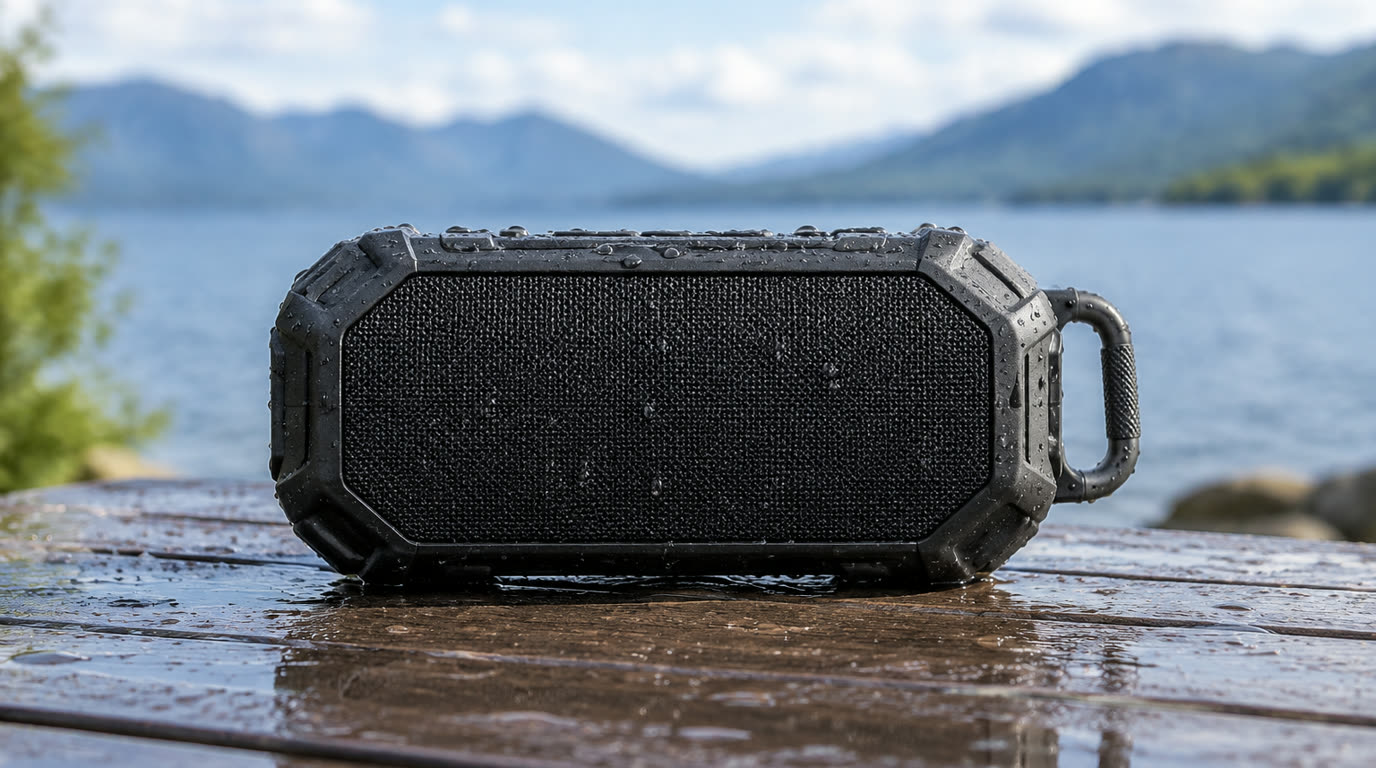
Spend this, not more: Spend $40–$130. The JBL Charge 5 (~$130) is the best all-round outdoor pick; the Boom 2 (~$90) and Tribit Micro 2 (~$40) cover smaller budgets. Above $150 buys bigger bass and party features, not more durability.
Quick answer:
- Best overall outdoor speaker: JBL Charge 5 (~$130) – loud, IP67, and it charges your phone.
- Best value: Anker Soundcore Boom 2 (~$90) – big output for the price, plus app EQ.
- Best ultra-portable: Tribit StormBox Micro 2 (~$40) – IP67 and a built-in strap.
- Best for the pool: Ultimate Ears Wonderboom 3 (~$100) – it floats.
What actually matters outdoors? Three things, in order: waterproofing, real loudness, and battery. Outdoors there are no walls to reflect sound, so a speaker that fills a bedroom can sound thin in a garden. Waterproofing decides whether the speaker survives the day at all.
How much should you spend? About $40-$70 buys a genuinely rugged small speaker. $90-$130 is the outdoor sweet spot: enough output for a small group, plus power-bank features. Above $200 you are buying size and bass for parties, which only makes sense if you host often.
First: Answer These 3 Questions
- Where exactly will it live? Pool or beach means IPX7 or IP67 and ideally a floating design. A covered patio can get by with splash resistance and better sound quality.
- How many people? One or two people: a $40-$60 speaker is plenty. A family gathering: 20W-plus. A party: consider two linked speakers rather than one big box.
- How long are you out? Half a day at high volume needs a speaker rated far above the claimed number, because cold and volume cut runtime. A power-bank feature is a real bonus.
5 Checks Before You Buy
| Check | Why it matters | Plain English |
|---|---|---|
| IP rating | IPX7 / IP67 | IPX7 handles a dunk; IP67 adds dust protection for sand and beach bags |
| Output | 20W+ for groups | Sound vanishes outdoors – power is not a marketing number here, it is a need |
| Battery | 12h+ rated | Expect to lose a third in cold or at high volume |
| Ruggedness | Rubberised shell | Outdoors, speakers get dropped and knocked over |
| Linking | Stereo / multi-pair | Two linked speakers beat one louder box for filling space |
2026 Top Picks for Outdoors (By Sound Quality & Long-Term Owner Reports, Not Paid Placement)
JBL Charge 5 – Best Overall Outdoor Speaker
Price: ~$130
Why: Big, clean output, an IP67 rating that shrugs off sand and rain, and a USB port that recharges your phone. It has been the default outdoor pick for years because it is loud without distorting and genuinely tough.
Honest take: The safest all-round choice. Downside: no app EQ on this model, and it is heavier than pocket speakers.
Anker Soundcore Boom 2 – Best Value
Price: ~$90
Why: 30W-plus of output with dual passive radiators, an IPX7 body, a custom EQ app, and even a light show. It out-punches its price for a party.
Honest take: Best loudness per dollar here. Downside: bass-forward tuning is not the most neutral, and the app EQ needs your phone.
Tribit StormBox Micro 2 – Best Ultra-Portable
Price: ~$40
Why: IP67, a built-in strap for a bike or backpack, and deeper bass than its size suggests. It has become the default clip-on recommendation for good reason.
Honest take: Unbeatable for carrying. Downside: small – it cannot fill a garden or a noisy beach crowd.
Ultimate Ears Wonderboom 3 – Best for the Pool
Price: ~$100
Why: It floats, it is drop-resistant, and it survives being dunked, which is exactly what a pool day demands. 360-degree sound means it does not need to be aimed.
Honest take: Built for water in a way most rivals are not. Downside: less bass than a JBL Charge at a similar price.
JBL Flip 5 – Best Loudness Per Dollar
Price: ~$90
Why: Clean, punchy sound, IPX7, and a 12-hour battery in a bottle-sized body. A dependable outdoor companion that is easy to pack.
Honest take: A workhorse. Downside: no microphone, no app EQ, and the Charge 5 is worth the small step up if you want more bass and a power bank.
One-Line Decision Table
| Your situation | Pick this |
|---|---|
| One speaker for everything outdoors | JBL Charge 5 |
| Loud party on a budget | Anker Soundcore Boom 2 |
| Bike, hike or backpack | Tribit StormBox Micro 2 |
| Pool and lake days | Ultimate Ears Wonderboom 3 |
| Cheap, loud and packable | JBL Flip 5 |
Running Costs: What You Pay After You Buy
The purchase price is only part of the story. Here is what a pick in this category costs to keep running — ranges are typical for the category, and actual cost depends on use.
| Item | What it is | How often | Typical cost |
|---|---|---|---|
| Consumables | None | — | ~$0/yr |
| Battery | Not user-replaceable on most models | Replace the speaker instead | ~3-year life |
| Optional case / strap | Protection and carry | Once | $10–$20 |
Skip It If… (When Buying Nothing Is the Right Call)
This is the section most buying guides leave out. If any of these describe you, the honest advice is to keep your money.
- You mostly listen indoors — an outdoor speaker trades sound quality for ruggedness you will not use.
- You want it for a small apartment — anything bigger than a bottle-size speaker is overkill.
- You need it to survive being dropped in a pool — only the floaters (Wonderboom 3) genuinely do.
Sources & Data
This guide uses official specifications, published results from named review bodies and long-term owner reports. Featured sources (verified 2026-09-23):
- RTINGS TV Reviews – independent laboratory measurements (peak brightness, input lag, HDR)
- RTINGS Headphones – independent audio measurements (frequency response, noise isolation)
- RTINGS Mice – independent gaming-mouse measurements (latency, weight, sensor)
- RTINGS Monitors – independent monitor measurements and recommendations
- RTINGS Home – independent lab tests across home electronics
- TechPowerUp GPU Specs – database of official GPU specifications
- SoundGuys – audio hardware testing and measurements
- What Hi-Fi Best Buys – independent audio/tv testing and awards
Table sizes, wattage and prices change; verify current specs at the manufacturer before you buy.
FAQ
What IP rating do I need? IPX7 or IP67 for anything near water. IPX4 splash resistance is fine for a covered patio only.
How loud does it need to be? Outdoors, sound vanishes without walls to reflect it. 20W-plus for a small gathering, 30W-plus for a party.
Can it survive drops? Look for a rugged or buoyant design with a rubberised shell. Floating speakers are built for pool use.
Does battery life drop outdoors? Yes. Cold and high volume can cut runtime by a third or more, so pick a speaker rated well above your expected use.
One big speaker or two smaller ones? For a large backyard, two linked speakers usually fill the space better than one louder box.
Real Pitfalls to Avoid
- IPX4 is not pool-proof – it means splashes, not dunks
- “100W” claims on tiny speakers are peak marketing figures – judge by real-world reviews
- Battery ratings assume moderate volume; cold weather and parties drain far faster
- Loud bass outdoors can distort if the speaker has no passive radiator – listen before trusting a spec
- Many budget speakers pair to only one device at a time – check multipoint if you share the music
Part of our coverage: best Bluetooth speakers under $100. See how we rank products.
Update note: refreshed quarterly. Prices checked Sep 2026, verify at checkout. Rankings based on platform sales and long-term owner reports, not paid placement.
>