
Quick answer: spend the money on the grinder first, then the machine
Under $300, the machine is 40% of the result; the grinder is the other 60%. A $180 machine + a decent $90 hand grinder beats a $280 machine + a $30 blade grinder every single day. If you can only upgrade one thing, make it the grinder.
Disclosure: We may earn a commission if you buy through links here — at no cost to you. We never take payment for rankings.
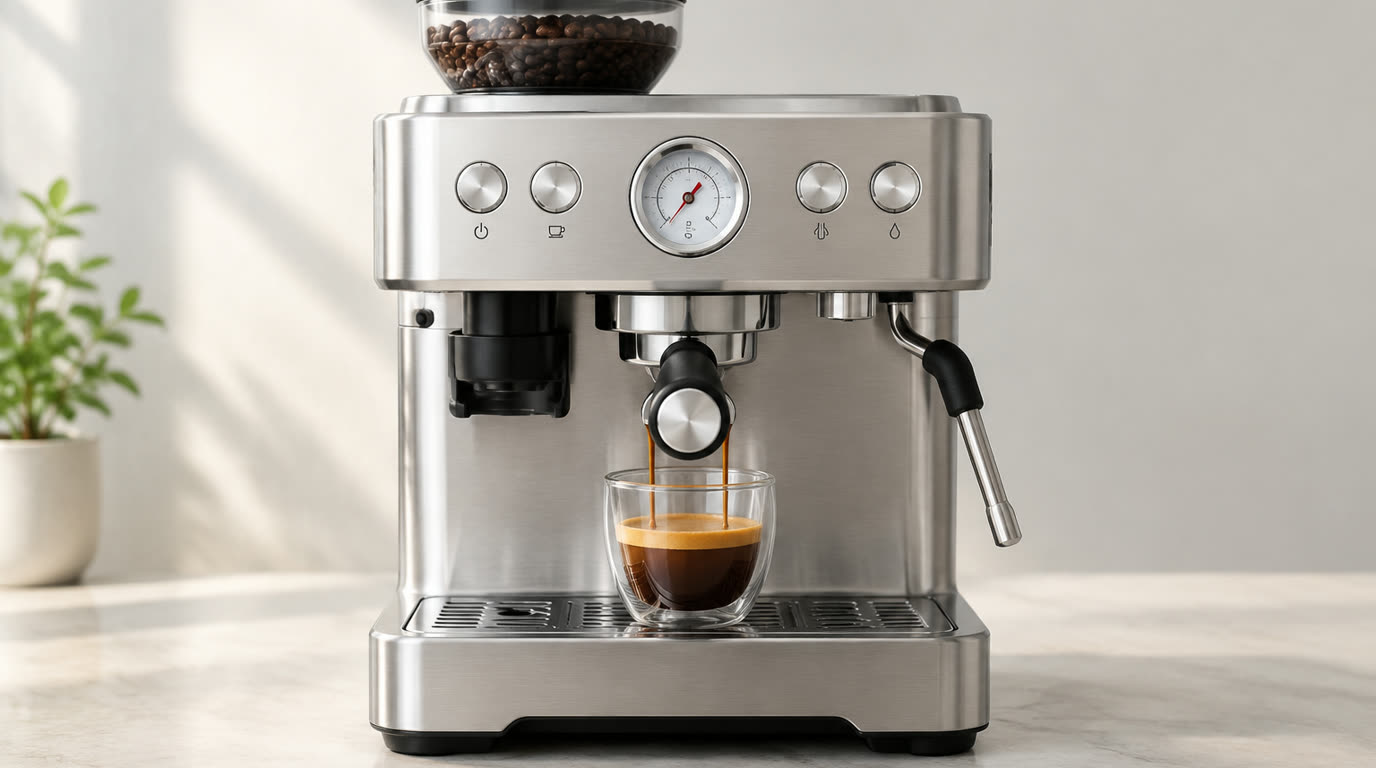
We don’t do “5 amazing options” fluff. Here are the only 3 machines that earn their price in 2026 — and the honest reason the $150 “espresso” strips are a waste.
Before you buy: 3 questions that decide everything
- How many milk drinks vs. straight shots? If you drink 80% lattes/cappuccinos, the steam wand quality matters more than the shot. If you drink straight espresso, you need a real non-pressurized basket.
- Do you already have a grinder? If no, you’re not shopping for a machine — you’re shopping for a grinder with a machine attached. Plan $80–$100 for a decent hand or electric burr grinder.
- Do you want to tinker or just press one button? Semi-auto (you control grind/shot) vs. super-auto (press = coffee). At under $300, super-autos make watery, bitter coffee — avoid unless you literally hate coffee-makig rituals.
The category trap: “15-bar” means nothing, and here’s why
Marketing would have you believe bigger bar numbers = better espresso. Real espresso is pulled at 9 bars. A machine advertising “15 or 20 bars” is either (a) lying, or (b) using that pressure for the steam wand, not the shot. Ignore the bar number. Look for a real 9-bar pump and a non-pressurized basket.
The other trap: “Automatic espresso machine” at this budget is a pressurized basket machine. It makes strong coffee with a fake crema — but it’s not espresso. If the product page mentions “pressurized basket” or “easy-to-use crema,” that’s marketing-speak for “this is not real espresso.”
Our picks
Best Overall — Breville Bambino Plus (~$330, often under $300 on sale)
Why: Real 9-bar semi-auto, 3-second heat-up, a genuinely good micro-foam steam wand for milk drinks, and a non-pressurized basket that makes actual espresso. This is the machine that changed what “under $350” means.
Honest take: 54mm portafilter (not the pro 58mm) limits some third-party accessories; it’s small and light (good for counters, meh for build feel); the steam wand needs a second to purge between milk drinks. But for shot quality per dollar, nothing else touches it.
Best for: Milk-drink lovers and anyone who wants genuine espresso without a big footprint or a huge price.
Best Value — De’Longhi Stilosa / EC-style (~$120, often under $100)
Why: True semi-auto with a 15-bar pump and a real portafilter for under $100. Add a good grinder and this genuinely pulls drinkable shots — the budget tier’s only honest answer.
Honest take: The steam wand is basic (no micro-foam, just steam); build is plasticky; it’s noisy; the basket is 51mm (fewer accessories). It’s not the Bambino — but at a third of the price, it’s the honest “learn espresso” pick.
Best for: First-timers who want to learn real espresso and don’t want to spend $300 to discover they don’t like the ritual.
Best Weird-but-Worth-It — Manual lever (Flair / Aeropress-style, $120–$200)
Why: No pump, no heating element to break — you ARE the pump. Real 9-bar extraction with zero electronics and zero maintenance. Compact, durable for years, and it teaches you espresso fundamentals fast.
Honest take: No steam for milk; it’s a ritual (measure, preheat, pull, purge — ~3–5 min per shot); and it’s a budget-friendly way to fall in love with the hobby. If milk drinks are non-negotiable, this is the wrong pick and the Bambino wins.
Best for: Purists, small kitchens, travelers, and espresso geeks on a budget.
One-line decision table
| Model | Price | Best for | Trade-off |
|---|---|---|---|
| Breville Bambino Plus | ~$330 (often <$300) | Milk drinks, real espresso, small counters | Price, small portafilter |
| De’Longhi Stilosa | ~$120 | Budget / first-timers | Basic steam, plasticky |
| Manual lever (Flair) | ~$160 | Purists, no milk needed | No milk steam, ritual |
Running costs: the honest budget
| Item | Typical |
|---|---|
| Beans (quality, 12oz) | $12–20 / week for daily use (~$0.30–0.55/shot) |
| Descaling | $5–10 / 2–3 months |
| Water filter | $8–15 / few months, if your area is hard |
| Grinder (if separate) | $15–30 / year of coffee |
| Total daily cost | ~$0.50–0.75 per drink — vs $4–6 cafe latte |
Real talk: The machine pays for itself in 2–3 months if you were buying 2 drinks a day. But the upgrade trap is real — “$330 machine” → “$450 grinder” → “$120 scale” happens to everyone. Set your budget before you start.
Skip it if…
- You only drink drip coffee or pods — a $30 French press or a pod machine is faster and cheaper for your habit
- You want to press one button and walk away — under $300, no super-auto makes good espresso; save up or buy a pod machine for consistency
- You don’t already have a grinder and won’t buy one — espresso without fresh grind is wasted money
- Counter space is tiny — these machines + a grinder need ~24 inches of depth
Still not sure? That is exactly why we publish how we rank and about us — the trade-offs are the whole point.
Also check our best toasters 2026 picks for more ideas.
Sources & Data
This guide uses official specifications, published results from named review bodies and long-term owner reports. Featured sources (verified 2026-09-23):
- ENERGY STAR Refrigerators – official energy-efficiency ratings across appliance types
- ENERGY STAR Dishwashers – official energy-efficiency ratings and water-use data
- ENERGY STAR Air Cleaners – official air-cleaner CADR and energy data
- Consumer Reports Air Fryers – independent appliance lab testing and reliability data
- AHAM – Association of Home Appliance Manufacturers – standards and certification
Table sizes, wattage and prices change; verify current specs at the manufacturer before you buy.
FAQ
Is a $150 espresso machine a waste?
Yes, mostly — unless it’s a pressurized-basket model you accept is making “strong coffee,” not espresso. The honest budget floor for real shots is ~$100 (Stilosa-style) plus a grinder.
Do I need a separate grinder for espresso?
For real espresso, yes. Grind size is the single biggest variable. A blade grinder can’t do it consistently; you need a burr grinder, hand or electric.
Is a manual lever machine hard to use?
The learning curve is ~2 weeks of daily pulls)Skip — but once you learn, it’s the cheapest way to genuinely great shotshare hand, maybe.
Still torn between two? Tell me your budget + floor type
Comment below, or check , — it explains exactly why one model ranks above another in our table.