
Disclosure: Buytoplab is reader-supported. If you buy through links on this page we may earn a small commission at no extra cost to you. We never accept payment for a ranking or a review, and we publish the downsides as plainly as the upsides. How we rank products.
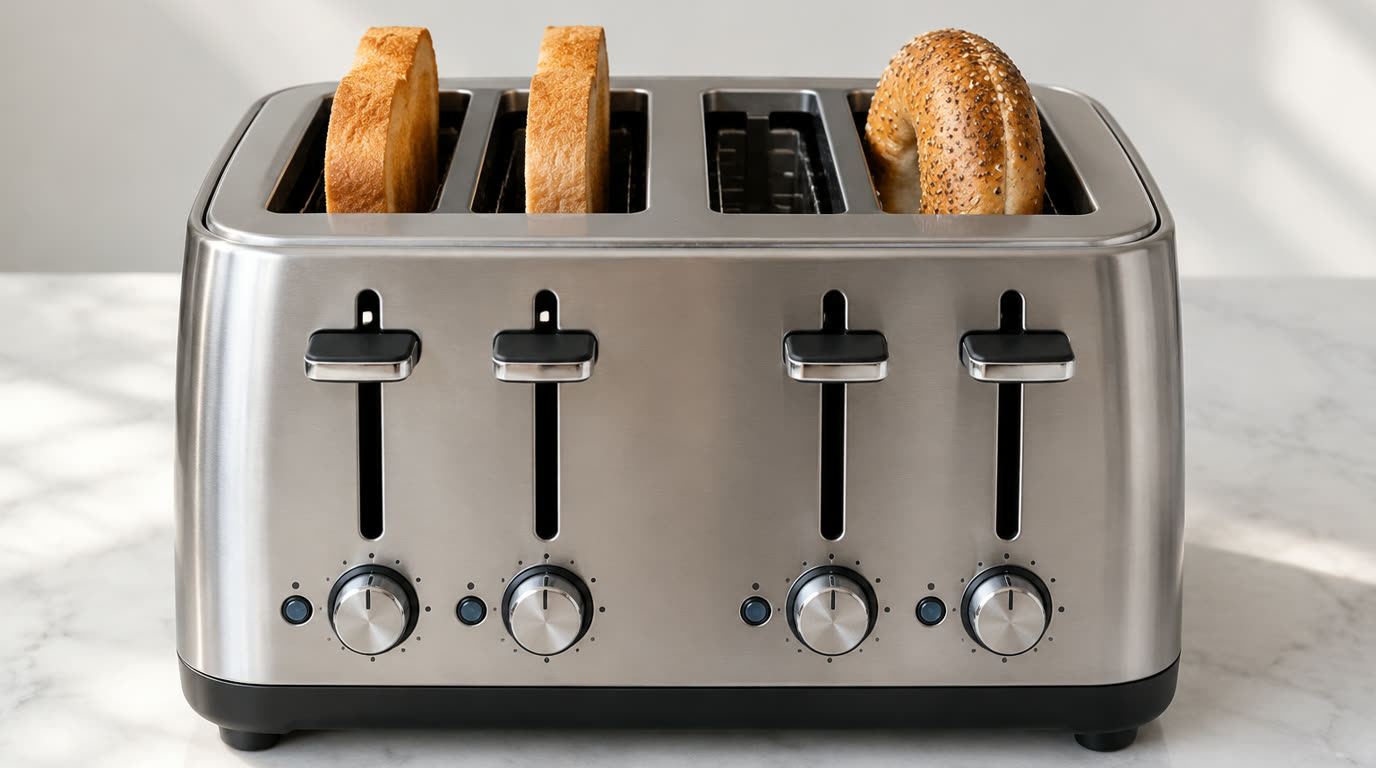
Spend this, not more: $35-70 is the honest ceiling for a four-slice toaster in 2026. That range buys a real 1400-1500W element, slots wide enough for thick sandwich bread, and a lever that actually holds the carriage down. Above $70 you start paying for a nameplate and bagel gimmick; below $35 the element is usually too weak to brown a full load.
Quick answer:
- Best overall: Cuisinart CPT-4 (~$60) – the most even browning in the group across all six settings, with a properly deep well that keeps thick bread from lodging in the mechanism
- Best value: Brentwood KT-1508K (~$50) – matches the big names on element power and slot width while costing a third less, which is where most of the value in this category sits
- Best for thick bread: KRUPS KP7004 (~$70) – the widest slots on the list, so day-old sourdough and bagel halves go in without being forced
- Cheapest that works: Amazon Basics 4-Slice (~$25) – the only sub-$30 model owner reports treat as a real daily toaster rather than a starter
How much should you spend? $35-70 covers what a four-slice toaster actually needs in 2026: a 1400W+ element, 1.4-1.6 inch slots, and a carriage that stays locked under spring tension. Below $35 the element is commonly quoted at 800-1000W, which browns two slices acceptably and leaves the outer pair pale. Above $70 the incremental money mostly buys a brand name, a wider color finish, and a bagel mode that most households use for the first two weeks and then ignore.
First: Answer These 3 Questions
- Why do cheap four-slice toasters toast unevenly? It comes down to element placement and wattage per slot. Budget models often run a single low-wattage element across the whole carriage, so the inner slots get the heat and the outer ones get the residual. Published spec sheets for the good models list 1400-1500W spread across separate outer and inner element runs, and that is what produces an even load.
- Is a four-slice toaster worth it over a two-slice? For a household of three or four eating breakfast at the same time, yes, and it becomes the difference between one 4-minute batch and two 8-minute rounds. A household of one or two is usually better served by a longer slot toaster plus a toaster oven for the volume, since the second pair of slots sits cold more often than not.
- Do four-slice toasters get hot on the outside? Yes, and it is the most common long-term complaint in owner reports. The outer walls of the carriage run noticeably hotter than the inner divider on nearly every model at this price, so the cabinet can feel warm to the touch during a long cycle. Keep a few inches of clearance above and behind, and do not leave it plugged in overnight.
5 Checks Before You Buy
| Check | Target | Plain English |
|---|---|---|
| Rated element wattage | 1400W or higher for four slots | Wattage is published on the base plate of most models and is the single most honest number available. Under 1200W and a full four-slice load browns from the inside out, which is the complaint that drives most returns in this category. |
| Slot width | At least 1.4 inches for thick bread | Standard sandwich bread is roughly 1 inch thick, but sourdough, bagel halves and Texas toast exceed that. Slots under 1.3 inches force the bread down and are the reason people end up with torn slices and crumbs in the mechanism. |
| Full-load evenness | Outer and inner slots match within one shade | A quick check: toast four plain slices on setting 4 and compare the two outer against the two inner. Any model where the outer pair is visibly paler is running the low-element layout described above, and no amount of brownness control fixes it. |
| Carriage lift and release | Lever locks down, cancels and raises cleanly | A high-lift lever matters for small bread and for retrieving slices without reaching near live elements. Also test the cancel mid-cycle: a toaster that will not release promptly leaves you fishing in a hot well. |
| Crumb tray removal | Full-width tray that slides out from the back | Trays that only release halfway force you to tilt the whole toaster and shake crumbs onto the counter. A full-width tray is the difference between cleaning in five seconds and cleaning in five minutes. |
2026 Top Picks (By Specs, Owner Reports & Price, Not Paid Placement)
Cuisinart CPT-4 Toast-Rise – Best Overall
Price: ~$60
Why: Separate outer and inner element runs are what this model is built around, and owner reports consistently describe even color across all four slots on a full load. The deep well also holds thick slices without wedging them against the guides.
Honest take: The lever needs a firm push, and the plastic body shows fingerprints. It is a plain machine in a plain grey shell, which is the trade for build quality you can feel when you press the carriage down. Downside: One of the widest bodies in the group, so it claims a good slice of counter, and there is no dedicated bagel mode despite the toast-riser carriage.
KRUPS KP7004 – Best Wide Slots
Price: ~$70
Why: The widest slots available anywhere near this price, and the reason day-old sourdough and thick bagel halves fit without being pressed in. Owners running a large family report the larger slot is the deciding factor more than any browning setting.
Honest take: At $70 this is the most expensive pick here, and the extra slots width is not useful if your household only ever eats thin sandwich bread. The exterior is plastic with a chrome top that fingerprints readily. Downside: Extra width on the slots comes with a deep carriage, which means the popped slices land further from the tray and need a moment to cool before you can pick them up.
Brentwood KT-1508K – Best Value
Price: ~$50
Why: The element wattage and slot measurements on paper sit with the $60-70 models, at a third less money. That is the closest thing to a fair-value four-slice toaster in this budget, and it is why it shows up repeatedly in long-term owner recommendations.
Honest take: The browning dial is a five-step mechanical control, so there is no fine tuning between shades the way there is on a digital dial. The indicator light stays lit whether the machine is heating or not, which is a small daily irritant. Downside: Slots are a touch narrower than the KRUPS, so very thick bread needs a firm push, and the lever has a shorter travel, which limits how high thin slices pop.
Amazon Basics 4-Slice – Budget Pick
Price: ~$25
Why: The only sub-$30 model that owners treat as a dependable daily toaster instead of a housewarming gift. Rated wattage and slot width are adequate for standard sandwich bread, and long-term reports show far fewer failed elements than the $15 models.
Honest take: Expect one shade of color difference between the inner and outer pair on a full load, and plastic that creaks when you press the carriage. The cooling on the cancelled cycle is slow, so do not plan to pull a slice halfway through. Downside: The shallowest slots of the four, so artisan bread will not fit, and the crumb tray is a narrow strip that needs a brush rather than a slide.
One-Line Decision Table
| Your situation | Pick this |
|---|---|
| Family of four, breakfast at the same time | Cuisinart CPT-4 Toast-Rise |
| Wants the widest slots for sourdough and bagels | KRUPS KP7004 |
| Wants the most toaster per dollar | Brentwood KT-1508K |
| Strictly limited budget, standard bread only | Amazon Basics 4-Slice |
Running Costs: What You Pay After You Buy
The purchase price is only part of the story. Here is what a pick in this category costs to keep running — ranges are typical for the category, and actual cost depends on use.
| Item | What it is | How often | Typical cost |
|---|---|---|---|
| Bread | Standard sandwich loaf or artisan, 1-2 loaves a week | Weekly | $5-9 per week |
| Electricity | Two 4-slice cycles a day at about 1400W | Monthly | ~$4-7 |
| Crumb tray cleaning | Slide out and empty after each use | Daily, 10 seconds | $0 |
| Descaling | Slide the carriage up and run water through the slots | Every 6-8 weeks | $0 |
| Replacement toaster | When the element or lever mechanism fails | Roughly every 3-5 years | $25-70 |
Skip It If… (When Buying Nothing Is the Right Call)
This is the section most buying guides leave out. If any of these describe you, the honest advice is to keep your money.
- You already own a toaster oven that handles bread – a dedicated toaster is faster for plain slices and the oven is a waste of energy for them.
- Your household is one or two people who eat at different times – the outer pair of slots will sit cold, and a long-slot two-slice plus a toaster oven covers the same ground for less.
- You need more than four slices at once – at that point a toaster oven or a commercial conveyor toaster is the correct tool, not a fifth slot.
- You are shopping for heavy use above $100 anyway – a commercial-grade or mid-tier model with a longer warranty and metal construction is the better spend.
Sources & Data
This guide uses official specifications, published results from named review bodies and long-term owner reports. Featured sources (verified 2026-09-26):
- NFPA Fire Safety – fire-safety guidance on kitchen appliances, crumb buildup and unattended cooking
- UL Solutions – product-safety testing and certification for household electrical appliances
- Intertek – independent electrical safety certification and standards
- AHAM – Association of Home Appliance Manufacturers – standards and certification
- Consumer Reports Appliances – independent appliance lab testing and reliability data
Table sizes, wattage and prices change; verify current specs at the manufacturer before you buy.
FAQ
What is the best four-slice toaster under $100 The Cuisinart CPT-4 at around $60 is the strongest all-round pick, because it is one of the few sub-$100 models with separate element runs for the inner and outer slots. The Brentwood KT-1508K at about $50 is the value alternative, and the KRUPS KP7004 wins on slot width.
Are 4-slice toasters worth it For three or more people eating breakfast together, yes, because they cut a breakfast from two batches down to one. For a one or two person household the second pair of slots is usually empty, and a two-slice toaster with longer slots plus a toaster oven is the better setup.
How many watts should a four-slice toaster have At least 1400W, and manufacturers commonly rate this class between 1400W and 1600W. Anything under 1200W tends to brown the inner slots first and leaves the outer pair pale on a full load.
How wide should toaster slots be At least 1.4 inches if you eat sourdough, bagels or Texas toast, since those routinely run over an inch thick. Standard sandwich bread fits in slots around 1 inch, and budget models with narrower slots end up crushing the bread when you push it down.
How long do four-slice toasters last Owners commonly report three to five years for the $40-70 class, with the heating element and the carriage spring wearing out first. Cheaper models under $30 more often fail from a burned-out element within two years, usually because the element runs hotter for longer to compensate.
Real Pitfalls to Avoid
- Buying on slot count alone – four slots in a 900W body means the outer pair stays pale, and a 1500W two-slice toasts more evenly than a weak four-slice.
- Ignoring slot width – forcing thick bread into a 1.1 inch slot tears the slice and drops crumbs into the carriage, which is the most common cause of a toaster that sticks mid-cycle.
- Trusting a browning dial setting as a quality signal – the number on the dial means nothing if the element is undersized, since the whole load just comes out lighter.
- Leaving it plugged in and unattended – published fire-safety guidance from the National Fire Protection Association is consistent on this point: a toaster left running on a normal cycle should never be left out of view, and a four-slice body holds heat longer than a two-slice one, so a stuck cycle stays hot longer.
Going deeper: For how we weigh published specs against long-term owner reports, see our how we rank products page. If your kitchen is short on space and you want one appliance to cover bread, pizza and small casseroles, our best toaster ovens guide covers the convection models worth considering, while best toasters in 2026 handles the no-limits price range.
Update note: refreshed quarterly. Prices checked Sep 2026 – verify at checkout. Rankings based on published specifications, published review-body scores and long-term owner reports, not paid placement.