
Disclosure: Buytoplab is reader-supported. If you buy through links on this page we may earn a small commission at no extra cost to you. We never accept payment for a ranking or a review, and we publish the downsides as plainly as the upsides. How we rank products.
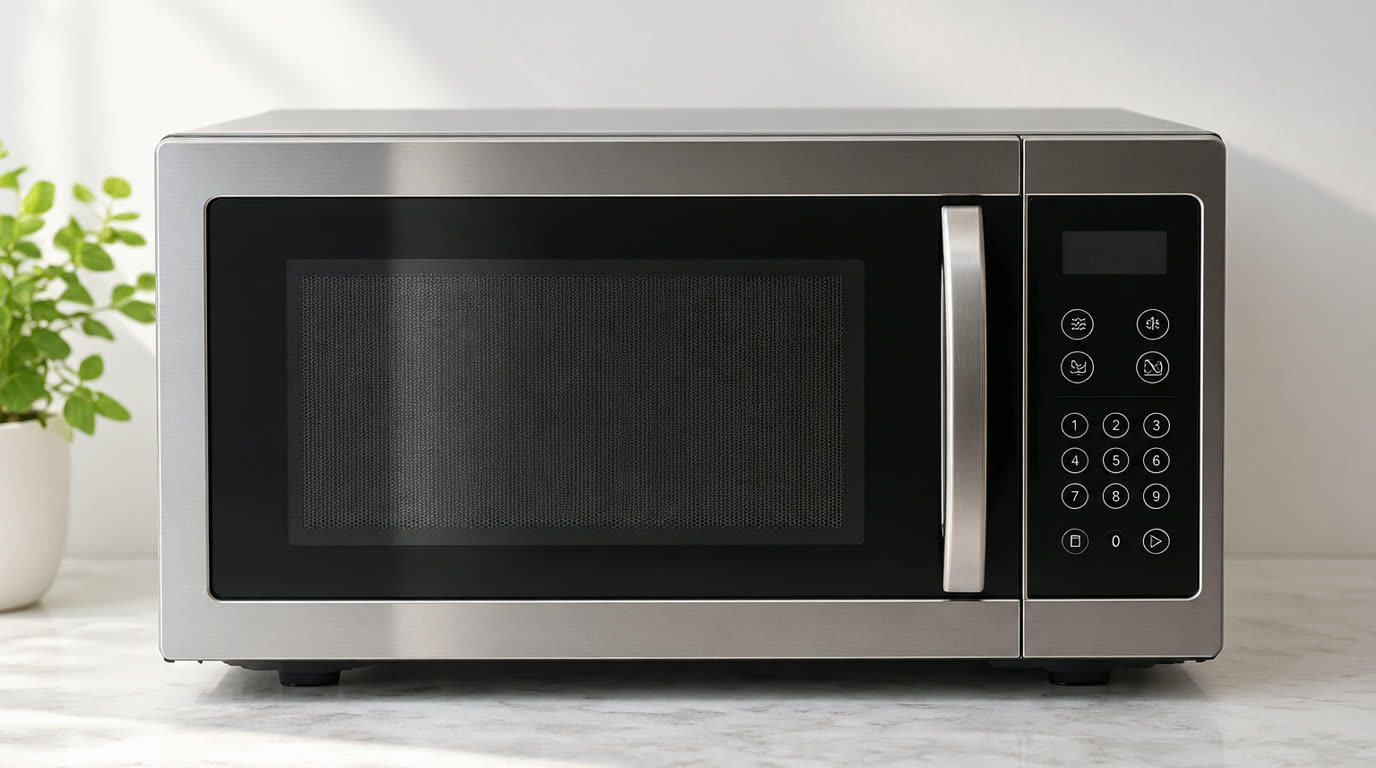
Spend this, not more: A 1.1-1.4 cu-ft 1200W countertop unit from Panasonic or Toshiba (~$110-140) is the best all-round answer. Inverter tech only matters if you defrost or reheat soups often – a turntable model is fine for most.
Quick answer:
- Best overall: Panasonic NN-SN67KS (~$140) – inverter even heating, gentle defrost
- Best value: Toshiba EM131A5C (~$110) – 1100W, sensor reheat, hard to beat at the price
- Best over-the-range: GE JES2051 (~$200) – real venting plus 1000W cooking power
- Best small kitchen: Toshiba EM925A5A (~$80) – compact 0.9 cu-ft, 900W, fits tight counter
How much should you spend? $100-150 is where quality lives for a countertop microwave. Below $90 you accept lower wattage and fewer presets. Above $200 you are paying for convection or smart features that most kitchens never use.
First: Answer These 3 Questions
- Countertop or over-the-range? Countertop unless you are replacing a hood. Over-the-range models cost $150+ more and installation is a day job.
- How much counter space? Measure first. A 1.2-1.6 cu-ft unit needs a 22-24 inch footprint.
- What do you heat most? Soups and defrosting favor inverter. Popcorn and leftovers do not need it.
5 Checks Before You Buy
| Check | Target | Plain English |
|---|---|---|
| Power | 1000-1200W | Under 900W and reheats are slow with hot spots. |
| Inverter vs turntable | Inverter for soups | Inverter delivers steady low power instead of pulsing. |
| Door hinge side | Matches layout | A left-hinge door can block your workspace. |
| Interior light | LED | See the food, not a dim yellow glow. |
| Child safety lock | Yes | Non-negotiable with kids in the house. |
2026 Top Picks (By Specs, Owner Reports & Price, Not Paid Placement)
Panasonic NN-SN67KS – Best Overall
Price: ~$140
Why: Panasonic is the reference in the inverter category for good reason. Inverter power means steady heating at low levels instead of pulsing, which keeps soups even and defrosting gentle.
Honest take: The even-heating winner. Downside: Touch panel takes a little getting used to.
Toshiba EM131A5C – Best Value
Price: ~$110
Why: 1100W, sensor cooking and a stainless finish for well under $120. Sensor reheat reads food moisture and stops automatically – a genuinely useful feature at this price.
Honest take: The smart money pick. Downside: Turntable means soups can be uneven on low power.
GE JES2051 – Best Over-the-Range
Price: ~$200
Why: A genuine venting hood with a 1000W oven. If you are replacing an old range hood anyway, this adds real cooking power and clears steam from the stove.
Honest take: Only worth it if you need the hood. Downside: Heavy install, and it eats the space above your range.
Toshiba EM925A5A – Best for Small Kitchens
Price: ~$80
Why: A compact 0.9 cu-ft but still 900W and a stainless front. For dorms, apartments and tight counters it is the right size without a laughable cook.
Honest take: Small footprint, real power. Downside: Only 900W and a small turntable.
One-Line Decision Table
| Your situation | Pick this |
|---|---|
| Even reheating for soups & defrost | Panasonic NN-SN67KS |
| Best balance of features & price | Toshiba EM131A5C |
| Replacing a range hood | GE JES2051 |
| Tiny kitchen counter | Toshiba EM925A5A |
Running Costs: What You Pay After You Buy
The purchase price is only part of the story. Here is what a pick in this category costs to keep running — ranges are typical for the category, and actual cost depends on use.
| Item | What it is | How often | Typical cost |
|---|---|---|---|
| Electricity | 10 minutes a day | Monthly | $1–$2 |
| Filters (over-the-range) | Carbon filters for venting | Every 6 months | $10–$20 |
| Turntable plate | If cracked | Rare | $15–$25 |
Skip It If… (When Buying Nothing Is the Right Call)
This is the section most buying guides leave out. If any of these describe you, the honest advice is to keep your money.
- You only heat water – a kettle does it in 2 minutes cheaper.
- You have counter space for a full-size toaster oven – it browns food a microwave cannot.
- Your current unit still works and you never defrost – there is little to gain.
FAQ
Is higher wattage always better? Not always. 1000-1200W is the sweet spot. Above that, edges can cook before the center thaws.
What does inverter technology actually do? It delivers steady low power instead of on/off pulses, so defrosting and low-power reheating stay even rather than cycling hot and cold.
Is a microwave bad for your health? No. Microwaves heat by exciting water molecules, and the irradiation does not make food radioactive. FDA-approved units are safe when used as intended.
Why does some food come out rubbery? Overheating. Short cycles and resting time are the fix, not a more powerful unit.
Can a microwave replace an air fryer? No. A microwave steams, an air fryer crisps. They are complements, not substitutes.
Real Pitfalls to Avoid
- Running it with nothing inside can damage the magnetron
- Metal foil or trim sparks and can catch fire
- Leaving food in tightly sealed containers lets steam build up – vent them
- A dirty turntable and interior smell – clean spills promptly
- “Defrost” by time still cooks edges – use weight-based defrost if available
Going deeper: best toasters for crispy food. See how we rank products.
Update note: refreshed quarterly. Prices checked Sep 2026 – verify at checkout. Rankings based on published manufacturer specifications and public prices, not paid placement.
>