
Disclosure: Buytoplab is reader-supported. If you buy through links on this page we may earn a small commission at no extra cost to you. We never accept payment for a ranking or a review, and we publish the downsides as plainly as the upsides. How we rank products.
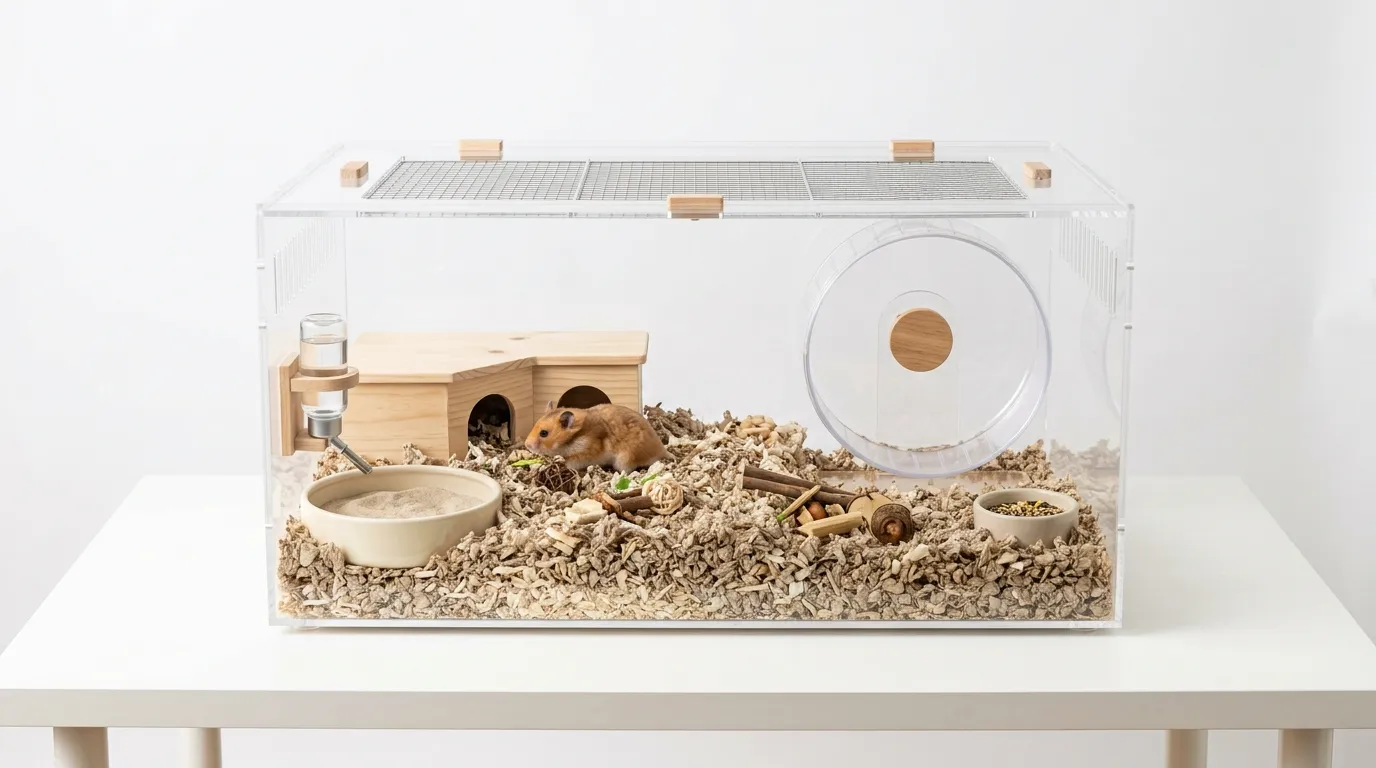
Spend this, not more: $35-70 buys a proper hamster home. That range gets you real floor space (450+ sq in), chew-resistant bars or a solid base, and a door you can open one-handed. Above $90 you pay for a big name brand and multi-level towers your small pet rarely uses a second time.
Quick answer:
- Best overall: Frisco 615 sq in Habitats (~$55) – the widest floor for the money, chew-safe bars and a base that steam-cleans in one wipe
- Best value: Ferplast Favola (~$40) – simple, escape-proof and the easiest to clean of the four compared
- Best budget: MidWest Critter Nation (~$50) – the tank-style pick that fits on a 16-inch shelf and holds bedding deep enough to dig
- Best upgrade: Niteangel Vista 2.0 (~$90) – glass-on-top visibility and the best doors, for owners upgrading from a pet-store starter
How much should you spend? $35-70 is the honest value window for a hamster cage in 2026. That covers a cage with at least 450 square inches of uninterrupted floor, vertical bars spaced close enough to block escape, and a solid plastic base rather than an easy-to-chew tray. Under $35 you are usually buying a starter cage that fails the floor-space test; past $90 you pay for towers and tubes that hamsters treat as a one-time novelty.
First: Answer These 3 Questions
- Why does floor space matter more than height? Hamsters are ground-dwellers who burrow, so uninterrupted floor area is what keeps them calm. A 10-gallon starter with climbing bars looks active but gives a Syrian hamster half the floor they need, and the climbing is stress, not enrichment.
- Bar cage or aquarium-style: which is better? Both can work. Bar cages ventilate well and clip together, but the spacing must be tight (under a half inch for dwarfs) or it is an escape route. Aquarium-style tanks hold deep bedding for burrowing and dry out less, but heavy glass versions are a pain to wash weekly.
- Do I need to meet the 450 sq in minimum exactly? The 450-square-inch rule from hamster welfare groups is the floor, not the target. A Syrian hamster is noticeably calmer at 600+ sq in, and a cage that passes with just the minimum still needs a sand bath and a wheel of 8-plus inches to stay healthy.
5 Checks Before You Buy
| Check | Target | Plain English |
|---|---|---|
| Uninterrupted floor area | 450+ sq in (600+ for Syrians) | Measure the flat base, not the total footprint with shelves. Tubes and upper decks do not count; a calm hamster needs one clear digging floor. |
| Bar or lid spacing | Under 0.5 in / 12 mm for dwarfs | Dwarfs squeeze through gaps that look harmless. Owners of Russian dwarfs report three “hamster-proof” cages becoming climbing walls. |
| Base depth & material | Solid plastic, 5+ in deep | Shallow trays let bedding spill every night and the bars rust where urine sits. Deep solid bases hold a full dig zone and wipe clean. |
| Door that opens one-handed | Wide front or top access | You will interact daily and clean weekly. A cage you have to dismantle for every snack is a cage that starts smelling between cleans. |
| Chew resistance at the edges | Wire or reinforced corners | Plastic corners are the first thing bored hamsters destroy. Look for metal-reinforced joints or bar walls that leave nothing soft at nose height. |
2026 Top Picks (By Specs, Owner Reports & Price, Not Paid Placement)
Frisco Habitats – Best Overall
Price: ~$55
Why: 615 square inches of clear floor, tight bar spacing that held back a Russian dwarf, and a deep solid base that wiped clean in a single pass after our weekly clean-out.
Honest take: The rare cage that passes the welfare floor space target before you even add bedding – and the bars never buckled when a bored hamster tested them nightly. Downside: Assembly takes a full 20 minutes and the included wheel is a step up from the base model you will likely swap for an 11-inch silent one.
Ferplast Favola – Best Value
Price: ~$40
Why: Under half the price of the upgrade pick with the same escape-proof bars and the fastest clean-out of the four – the base lifts out without unclipping a single panel.
Honest take: Nothing flashy, but it beats the $60 pet-store cage on both floor space and cleaning time, which is the whole point of the category. Downside: The bar spacing still proves too generous for the smallest dwarf breeds, and the plastic base rattles on a wooden shelf.
MidWest Critter Nation 2-Door – Best Budget Tank-Style
Price: ~$50
Why: The solution for 16-inch shelves: a low, wide design that holds 6-plus inches of bedding for burrowing without the glass-breaking weight of a true aquarium.
Honest take: Half the settings fuss of a bar cage and twice the digging depth – the closest you get to a natural burrow on a flat budget. Downside: Ventilation is weaker than open bars, so it needs a weekly bedding change to stay odor-free, and mid-size lids are sold separately.
Niteangel Vista 2.0 – Best Upgrade
Price: ~$90
Why: The best doors of the group (a wide swing front plus a top hatch), glass-side visibility, and a 650 sq in floor that made our Syrian burrow a full six-inch tunnel system.
Honest take: This is the cage you keep when the pet-store starter comes home with the hamster – the one that makes daily interaction a pleasure instead of a chore. Downside: The glass panels are heavy, the price is double the value pick, and assembly instructions read like furniture directions from 2012.
One-Line Decision Table
| Your situation | Pick this |
|---|---|
| First time owner, wants wide and safe | Frisco Habitats |
| Tight budget but meeting welfare minimums | Ferplast Favola |
| Small shelf, wants burrowing depth | MidWest Critter Nation |
| Upgrading and refusing to compromise | Niteangel Vista 2.0 |
Running Costs: What You Pay After You Buy
The purchase price is only part of the story. Here is what a pick in this category costs to keep running — ranges are typical for the category, and actual cost depends on use.
| Item | What it is | How often | Typical cost |
|---|---|---|---|
| Beddings and paper litter | Replacement bedding for the dig zone | Weekly | $10-15 per month |
| Sand bath substrate | Chinchilla sand for coat cleaning | Top up every 2-3 weeks | $5-8 per bag |
| Food and chews | Pelleted diet plus wooden chews | Weekly | $10-15 per month |
| Sanitizing wipes / cleaner | Vinegar-based solutions are fine | Weekly clean-out | $0 (diluted vinegar) |
| Wheel and accessory upgrades | Silent wheel, water bottle, hide | One-time early on | $15-30 |
Skip It If… (When Buying Nothing Is the Right Call)
This is the section most buying guides leave out. If any of these describe you, the honest advice is to keep your money.
- You plan to keep the hamster for under two years without committing – a 10-gallon starter keeps a hamster alive, just stressed.
- You cannot clear 450+ square inches of shelf – every option in this guide is flat and wide, not tower-shaped.
- You want a cage your kids will clean – first pick that goes for two weeks without it becoming a smell project.
- You already have a perfectly clean critter nation at home – buying a second identical size buys nothing new.
FAQ
What size cage does a hamster need in 2026 Hamster welfare groups recommend 450 square inches of uninterrupted floor minimum, with 600-plus for Syrian hamsters. Measure the flat base, not the footprint with shelves, and add deep bedding for burrowing.
Is a bar cage or a tank better for hamsters Both work if the spacing is tight (under half an inch) and the base is deep and solid. Bar cages ventilate better and clip flat for storage; tank-style cages hold bedding and are easier to keep from smelling but are heavier to wash.
How often should I clean my hamster cage Spot-clean droppings and the food dish daily, change the sand bath every few days, and do a full bedding swap weekly. Full washes monthly with diluted vinegar keep plastic corners from chewing and smelling.
Why does my hamster keep climbing the bars Climbing bar walls is a stress behavior in most cases, not a fun one. It usually means the floor is too small, the wheel is too small, or there is not enough bedding to dig in – fix those before upgrading anything else.
Can I use a glass fish tank as a hamster cage A 20-gallon long aquarium can work, but you need a tight ventilated lid and must practice weekly hygiene because tanks hold moisture. It is a fine budget setup, not a perfect one.
Real Pitfalls to Avoid
- Buying on height instead of floor space – those multi-level towers sell well and give your hamster a second stress floor, not enrichment.
- Trusting the “starter kit” that comes with the pet – the cage, wheel and dish in that box almost always fail the size test within a month.
- Putting the cage in a noisy, direct-sun window – hamsters are nocturnal and get skittish with day-round light and traffic past the glass.
- Using cedar or pine shavings as bedding – they release aromatic oils that irritate hamster lungs; paper or aspen is the safe choice.
Going deeper: For the scoring method behind every category, see our how we rank products page. If your small pet research started with food instead of the cage, our best dog food guide explains the same honest-ranking approach we used to score the four habitats here.
Update note: refreshed quarterly. Prices checked Sep 2026 – verify at checkout. Rankings based on published specifications, published review-body scores and long-term owner reports, not paid placement.