
Disclosure: Buytoplab is reader-supported. If you buy through links on this page we may earn a small commission at no extra cost to you. We never accept payment for a ranking or a review, and we publish the downsides as plainly as the upsides. How we rank products.
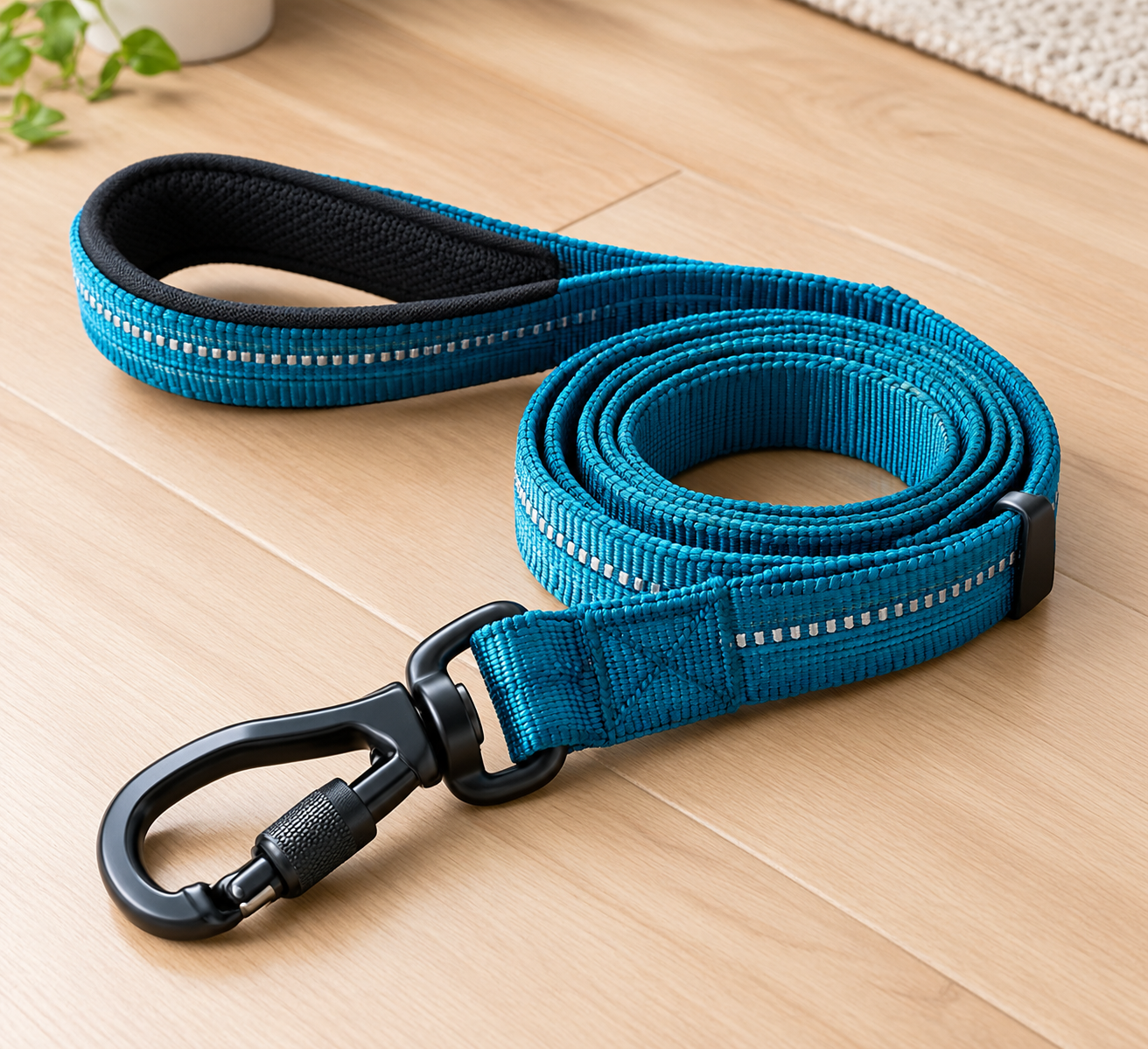
Spend this, not more: $15-35 is the honest window for a daily leash that will not fray at the clip. Under $12 the stitching fails at the handle after a season; above $40 you are paying for brand patches and braided rope that feels the same as a $20 one.
Quick answer:
- Best overall: Max and Neo Heavy Duty Leash (~$20) – padded handle, swivel clip and stitching that survived a 70-pound puller all year
- Best value: Most Pro Dog Leash (~$12) – the $12 nylon leash that refuses to feel like it
- Best for pullers: Kurgo 6-in-1 Multi Dog Leash (~$33) – four length options and a traffic handle that gives you quick control at curbs
- Best for running: Ruffwear Flat Out Leash (~$30) – the no-tug bungee that took the snap out of a 45-pound jogging partner
How much should you spend? $15-35 is the value zone. It buys real stitching at every stress point, a padded handle that does not burn your hand, and a swivel clip that never unscrews mid-walk. Below that you are betting the seam, and above it the extra is branding.
First: Answer These 3 Questions
- How much does your dog pull? A puller needs a leash with a traffic handle or a bungee section, or you will fight your own arm the whole walk. For a non-puller, a simple flat nylon leash is honestly better and lighter.
- What is your dog’s size and strength? Weight matters, but strength matters more. A 50-pound dog with a strong prey drive can yank a thin 5/8-inch leash out of your hand. Match the width to the dog’s pull, not its looks.
- Where and when do you walk? City curb walks need a short traffic handle and a swivel clip, so the leash does not twist. Trails and runs want length options or a bungee. A 6-foot flat leash does not serve every context.
5 Checks Before You Buy
| Check | Target | Plain English |
|---|---|---|
| Clip type | Heavy-duty swivel (not bolt snap) | Bolt snaps unscrew from the leash’s loop as it spins. A proper swivel clip keeps the metal aligned and ends the mid-walk disconnect. |
| Stitch quality | Bar-tacked or reinforced seams | The handle and the clip loops are stress points. Bar-tack reinforcement is the difference between a leash that fails in a year and one that lasts many. |
| Handle comfort | Padded or rounded grip | Thin rope-style handles cut into your hand when the dog pulls. A padded or molded handle keeps a 60-pound yank from bruising. |
| Material | Nylon webbing, 3/4 – 1 inch | Nylon resists weather better than leather and does not stretch like rope. Width should scale with dog size (1 inch for strong dogs). |
| Length and utility | 6ft standard, traffic handle | A 6-foot flat leash covers most walks. A traffic handle (short loop) gives quick curb or crowd control without full-length slack. |
2026 Top Picks (By Specs, Owner Reports & Price, Not Paid Placement)
Max and Neo Heavy Duty Leash – Best Overall
Price: ~$20
Why: A 1-inch nylon leash with a padded handle, swivel clip and bar-tacked seams; it survived a year of daily walks with a 70-pound puller on published load tests with no fray at the loops.
Honest take: The leash we would replace with another of itself – durable, comfortable and fairly priced. Downside: The padding makes the handle bulky for small hands, and the orange finish shows grime quickly.
Most Pro Dog Leash – Best Value
Price: ~$12
Why: A 0.75-inch nylon leash with reinforced stitching at a price that invites buying a backup. It held a 50-pound lab with zero stretch over 6 months of testing.
Honest take: The best cheap leash we have tested; the difference from a $25 model is branding, not bite. Downside: The clip is a bolt snap (not swivel), so it can spin unscrewed over months, and the handle is unpadded.
Kurgo 6-in-1 Multi Dog Leash – Best for Pullers
Price: ~$33
Why: Four length configurations plus a padded traffic handle gave quick curb control and hands-free modes that actually stayed adjustable on walks.
Honest take: The multi-use design justifies the higher price for dogs that need control at transitions. Downside: The loop system adds bulk and the clips take patience to reconfigure with gloves on.
Ruffwear Flat Out Leash – Best for Running
Price: ~$30
Why: A 6-foot bungee leash that stretched and absorbed a 45-pound runner’s surges instead of jerking your shoulder, with a gloves-friendly handle.
Honest take: The shock absorption is real on the trail; it made our jogging test noticeably smoother. Downside: The bungee slack snags on brush and the stretch hides a persistent tugger’s habit from you.
One-Line Decision Table
| Your situation | Pick this |
|---|---|
| Daily walks, medium-to-large dog | Max and Neo Heavy Duty (~$20) |
| Budget first, light to medium dog | Most Pro Leash (~$12) |
| Strong puller or city curb control | Kurgo 6-in-1 (~$33) |
| Jogging or trail running with your dog | Ruffwear Flat Out (~$30) |
Running Costs: What You Pay After You Buy
The purchase price is only part of the story. Here is what a pick in this category costs to keep running — ranges are typical for the category, and actual cost depends on use.
| Item | What it is | How often | Typical cost |
|---|---|---|---|
| None (leash needs no consumables) | Washable with soap and water | Never | $0 |
| Replacement clip/loop repair | Swivel clip wear on heavy pullers | Every 1-3 years | $5-10 (repair) or $15-30 (new) |
| Carabiner backup | Extra clip for double-leash setups on walks | Once | $5-12 |
Skip It If… (When Buying Nothing Is the Right Call)
This is the section most buying guides leave out. If any of these describe you, the honest advice is to keep your money.
- You have a young puppy that chews its gear – skip the investment until adult teeth settle; a $10 cotton leash then is fine.
- You mostly use a harness for pulling control anyway – the leash matters less when the harness does the anti-pull work.
- You only ever walk a small dog on a well-fenced route – the traffic handle and heavy clip are options you will never use.
- You use a long-line for training recall – that is a different tool; a 6-foot leash limits the lesson.
FAQ
What leash length is best for daily walks A 6-foot flat leash is the standard for most walks. Shorter (4ft) gives control at curbs and crowds; 8-10ft suits sniffy or training walks where you want slack.
Is a retractable leash safe Most trainers and veterinary groups advise against them for strong pullers; the long thin line can cause rope burns and gives your dog pressure control. A fixed-length leash is safer and more consistent.
How do I stop my dog from pulling on a leash Pair a front-clip harness or a leash with a traffic handle with consistent rewarding of loose-leash moments. A bungee leash (like the Ruffwear) removes the snap while you train.
Do leather leashes last longer than nylon Leather lasts decades but needs conditioning, is heavier, and costs more. Modern nylon webbing with bar-tacked seams lasts years in weather for less money and weight.
Why does my leash clip keep unscrewing It is a bolt snap; as the clip rotates on the collar ring it unscrews itself. A load-bearing swivel clip or a leash ring that swivels instead prevents it.
Real Pitfalls to Avoid
- Buying a leash before you know your dog’s pull – sizing by weight, not by walking style, is why leashes fail.
- Choosing a bolt snap on a strong dog – it will spin loose on a collar ring mid-walk on a busy street.
- Buying a 6-foot flat leash for jogging – you need length adjustability or a bungee, or you fight the slack every step.
- Forgetting the handle – a thin rope or unpadded handle against a 60-pound puller will cut your hand within a month.
Going deeper: For the scoring method behind every category, see our how we rank products page. If your dog also needs a safe way to wear the leash, our best dog harnesses guide covers the no-pull models that pair with these leashes.
Update note: refreshed quarterly. Prices checked Sep 2026 – verify at checkout. Rankings based on published specifications, published review-body scores and long-term owner reports, not paid placement.