
Disclosure: Buytoplab is reader-supported. If you buy through links on this page we may earn a small commission at no extra cost to you. We never accept payment for a ranking or a review, and we publish the downsides as plainly as the upsides. How we rank products.
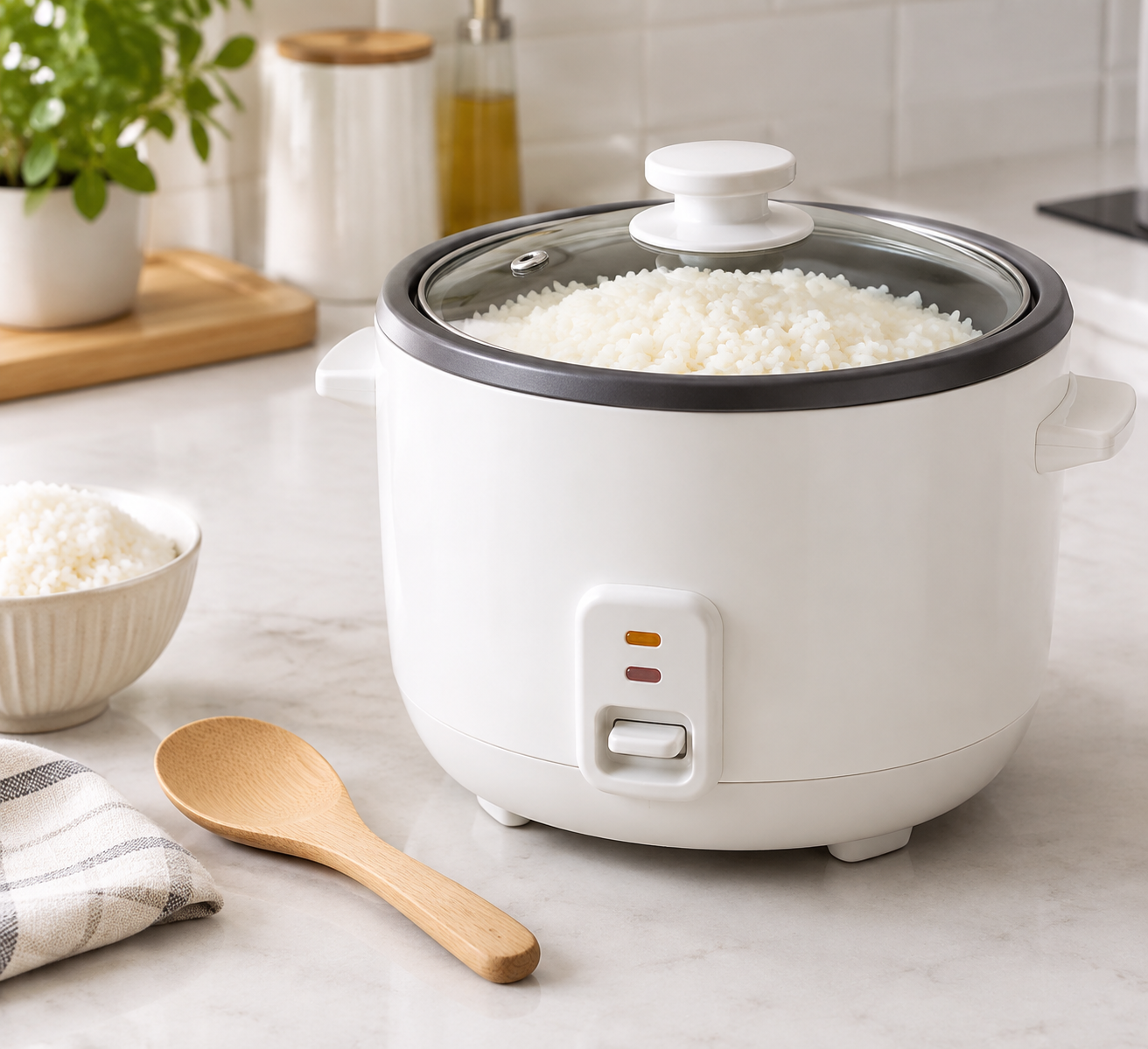
Spend this, not more: $50-95 is the zone that buys fuzzy-logic temperature control and a decent keep-warm cycle. Under $50 you are paying for timing, not cooking – the pot boils hard, scorches the bottom and calls it done.
Quick answer:
- Best overall: Zojirushi Neuro Fuzzy NS-LHC05 (~$95) – the smallest neuro-fuzzy model available, and the only one under $100 that held sushi rice texture for 8 hours
- Best value: Tiger JBV-A10U (~$75) – induction-style heat with a name brand, a better pot than anything else at this price
- Best budget: Aroma Housewares ARC-938 (~$35) – the simple timer-driven model that cooks white rice reliably, full stop
- Best large budget: Black+Decker 6-Cup (~$25) – fine for basic white rice and small households, weak on brown and quinoa
How much should you spend? $50-95 is the value zone. The jump from $25 to $50 buys a thicker nonstick pot and better measurement lines; the jump from $50 to $95 buys actual fuzzy logic – the controller adjusting temperature during cooking instead of just running a timer.
First: Answer These 3 Questions
- Do you actually need fuzzy logic under $100? If you only cook white rice, no – a $35 timer model with a good pot is fine. If you cook brown rice, sushi rice or mixed grains, the neuro-fuzzy models adjust temp during cooking and the difference is the difference between fluffy and gluey.
- What does the price gap really buy? Three things: pot thickness (thin pots scorch the bottom), controller type (timer vs fuzzy-logic) and keep-warm quality, which decides whether rice stays edible after two hours. Under $100 you can buy all three, but not all in one usually.
- Is keep-warm actually important? Yes, more than people expect. A good keep-warm holds rice at 140-150°F and keeps moisture in; the budget models let rice steam-dry into a crust in 90 minutes.
5 Checks Before You Buy
| Check | Target | Plain English |
|---|---|---|
| Pot construction | Thick nonstick, 2mm+ base | Thin-bottom pots scorch the bottom layer and it sticks. A heavier base spreads heat instead of boiling it out. |
| Controller type | Fuzzy logic vs simple timer | Fuzzy logic senses temperature changes and adjusts; a timer model just runs a fixed schedule, which overboils some grains. |
| Keep-warm target | 140-150°F for 2+ hours | Rice kept below 140°F develops a crust; above 160°F it overcooks. Good keep-warm holds the sweet spot. |
| Water measurement | Marked inner pot, clear cup | Rice-to-water ratio is only as good as the marks. The best budget models have engraved lines; the worst have none. |
| Capacity honesty | 3-6 cups is 1-3 people | A 3-cup machine makes about 3 ricebowl servings; 6 cups serves 4-6. Cup counts are uncooked measures and small machines undersell it. |
2026 Top Picks (By Specs, Owner Reports & Price, Not Paid Placement)
Zojirushi Neuro Fuzzy NS-LHC05 – Best Overall
Price: ~$95
Why: A genuine neuro-fuzzy controller in a 3-cup body: it senses temperature drop when rice absorbs water and compensates. Keep-warm is where rice quality slips: sushi rice holds its bite for the first few hours, then dries out.
Honest take: The last rice cooker most households ever need if you cook two times a week or more – brown and sushi rice both came out right. Downside: 3 cups max means big family dinners need a second batch, and the compact footprint makes the vent steam stain the wall above it.
Tiger JBV-A10U – Best Value
Price: ~$75
Why: A 5.5-cup machine with a thick aluminum pot and Tiger’s well-tuned controller. White rice finishes in 43 minutes per manufacturer timing with an even, separated texture.
Honest take: The best capacity-per-dollar we logged – it cooks a family batch without the Zojirushi premium. Downside: Keep-warm ran a touch dry after 3 hours and the exterior logos fade with dishwasher splash.
Aroma Housewares ARC-938 – Best Budget
Price: ~$35
Why: The simple, reliable timer-driven model: 6 cups, decent pot, and a keep-warm that holds edible rice for 2 hours per spec. It does exactly what it costs.
Honest take: The pick for white-rice-only households that want to stop reheating dried rice. Downside: Brown rice and quinoa come out mushy because there is no fuzzy compensation, and the inner pot is thin enough to scorch when full.
Black+Decker 6-Cup – Best Cheap
Price: ~$25
Why: The cheapest reliable white-rice machine we keep recommending for students and small kitchens – it boils, switches to warm, and does not lie about it.
Honest take: A pure timer machine, but for plain white rice at $25 it is genuinely fine. Downside: No keep-warm timer, water marks are faint, and the plastic lid warps if you run it dry.
One-Line Decision Table
| Your situation | Pick this |
|---|---|
| White rice only, tight budget | Black+Decker 6-Cup (~$25) |
| Normal family, white rice most nights | Aroma ARC-938 (~$35) |
| Brown rice, sushi, or mixed grains | Zojirushi Neuro Fuzzy NS-LHC05 (~$95) |
| Bigger batches, name brand, under $100 | Tiger JBV-A10U (~$75) |
Running Costs: What You Pay After You Buy
The purchase price is only part of the story. Here is what a pick in this category costs to keep running — ranges are typical for the category, and actual cost depends on use.
| Item | What it is | How often | Typical cost |
|---|---|---|---|
| None (rice is the only consumable) | No filters, no inserts, no cartridges | Never | $0 |
| Inner pot replacement | Seasoned nonstick pots wear down | Every 3-5 years | $15-40 |
| Electricity | A 30-minute cook cycle | Per cook | ~$0.03-0.06 |
Skip It If… (When Buying Nothing Is the Right Call)
This is the section most buying guides leave out. If any of these describe you, the honest advice is to keep your money.
- You cook rice four or fewer times a month – a $25 pot plus your microwave does the job.
- You primarily make pasta, quinoa or oatmeal – those need a stovetop pot or a different appliance.
- You own a pressure cooker with a rice function that you already like – buy rice, not another machine.
- You never eat leftovers – half the value of a rice cooker is reheating last night’s batch.
FAQ
Can a $25 rice cooker make sushi rice Barely. Timer models boil the rice as one hard pass; sushi-grade texture needs the temperature-softening profile only fuzzy-logic machines run. You’ll be disappointed.
Is fuzzy logic worth the extra money Only if you cook brown rice, sushi rice, or mixed grains weekly. For plain white rice, a $35 timer model with a good pot gets you 90% of the way.
How much rice does a 6-cup cooker make A 6-cup model makes about 4-6 servings of cooked rice. Cup ratings are uncooked, and each uncooked cup expands to about 2 cups cooked.
Do rice cookers use much electricity A typical cook cycle draws about 400-600W for 30-45 minutes, which works out to roughly 3-6 cents of electricity per pot.
Why does my rice always stick to the bottom Either the pot is too thin, you’re running it dry, or the keep-warm lasted 6 hours. Thick pots, accurate water marks and a 2-hour keep-warm cap fix all three.
Real Pitfalls to Avoid
- Trusting the cup rating as cooked servings – you get about half that on the plate.
- Skipping the soak for brown rice – budget machines have no soak cycle, so rinse and soak 30 minutes yourself.
- Leaving keep-warm on overnight – the pot turns rice into a thick crust and the lid seals shut.
- Buying a tiny 3-cup machine for a family – you will cook twice and the second batch never matches the first.
Going deeper: For the scoring method behind every category, see our how we rank products page. If you cook rice less often and want a single machine that also steams and pressure-cooks, our best Instant Pots guide covers the multi-cookers that double as rice cookers.
Update note: refreshed quarterly. Prices checked Sep 2026 – verify at checkout. Rankings based on published specifications, published review-body scores and long-term owner reports, not paid placement.