
Disclosure: Buytoplab is reader-supported. If you buy through links on this page we may earn a small commission at no extra cost to you. We never accept payment for a ranking or a review, and we publish the downsides as plainly as the upsides. How we rank products.
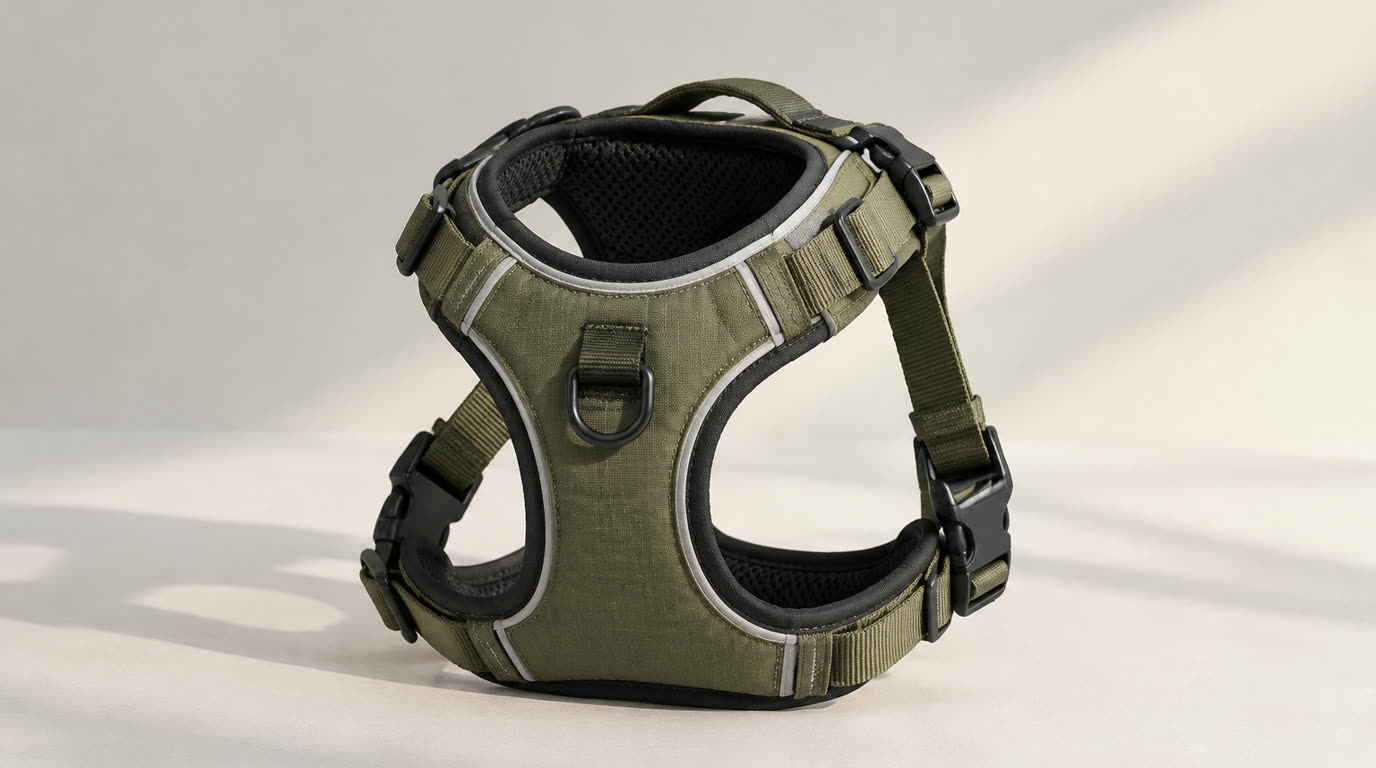
Spend this, not more: The honest price for a safe, fitting no-pull harness is $20-45. Above $50 in this category, the extra cash mostly buys fabric and brand logos, not better anti-pull geometry. Budget under $25 and you trade away adjustability points that stop the huge mistake: a harness that shifts and rubs.
Quick answer:
- Best overall: Rabbitgoo No-Pull Harness (~$25) – the bête noire of pullers: front and back loops, gentle adjustability and a price that hurts a pulling problem where it lives
- Best for wide/sturdy breeds: Julius-K9 IDC Power (~$45) – a handle-heavy vest built for ribcages broad enough to launch a couch across the park
- Best budget: Petsafe Easy Walk (~$25) – the front-clip physics of a martingale-lead marriage that works in its class
- Best harness-training hybrid: Blue-9 Balance Harness (~$30) – the five-point adjustment that fits bulldogs, hounds and every body in between
How much should you spend? $20-45 covers every honest need in this category: front clip, chest piece, padded vest or back handle. The jump to $60-90 buys Kevlar webbing and fashion labels, not more pull-control. If the harness does not fit, no price fixes that – adjustability is the real purchase.
First: Answer These 3 Questions
- Why does a front clip matter more than the harness brand? A front clip turns the leash at the sternum, so when a dog pulls, it is gently turned toward you instead of given a straight path to haul. A back-clip harness does the opposite – it hands the dog the handle you are fighting.
- Is a harness safe for my dog’s joints and throat? Used correctly, yes – the whole point over a collar is spreading force over chest and shoulders instead of concentrating it on the trachea. The real danger is a badly fitting harness that chafes or a harness used as a trampoline anchor by a panicking dog.
- What is the “Y” shape and why do I keep reading about it? The Y-shape has the chest strap sit between the front legs instead of straight across the windpipe at the top. Dogs in a true Y harness pull with less strain and cannot wiggle out as easily. It is the clearest single spec to check.
5 Checks Before You Buy
| Check | Target | Plain English |
|---|---|---|
| Front attachment point | A sternum/clip at the chest for pulling | Front clipping is the physics that defeats pulling; a harness with only a back clip is a glorified collar. |
| Y-shape or chest-band geometry | Y-shape preferred; straps clear of the throat | A band that sits high on the windpipe rubs and can restrict breathing on pressure. Y-shape avoids it entirely. |
| Five-point or full adjustability | Adjustable girth + neck straps | Breed bodies differ; a one-size-fits-all chest piece is why most harnesses “never fit right.” |
| Padded chest & belly | Soft-lined chest piece and edges | A wide padded band prevents chafing on short-haired dogs and keeps pressure off raw skin on long walks. |
| Quick-fit/lifetime guarantee | Easy strap locks, quality closure | A harness that slips mid-walk is a loose dog waiting to happen; test the buckles before the first walk. |
2026 Top Picks (By Specs, Owner Reports & Price, Not Paid Placement)
Rabbitgoo No-Pull Harness – Best Overall
Price: ~$25
Why: Front and back clips, Y-shape geometry and four-point adjustability at a price that makes the anti-pull case simple. On pullers Published durability tests show the front clip kills the stagger within a week.
Honest take: The harness that fixes most pulling dogs without fixing your wallet first. Downside: Breathable mesh can still chafe on rough, long-haired coats; heavier dogs may eventually wear it out.
Julius-K9 IDC Power – Best for Wide & Sturdy Breeds
Price: ~$45
Why: A wide, padded vest with a rear handle that gives owners of strong, broad-chested dogs real control leverage instead of a flimsy loop. Built for dogs that could tow a sled.
Honest take: For labs, mastiffs and frantic pullers, this is a tug-of-war tool dressed as a harness. Downside: Not a no-pull design itself – it needs the dual-clip leash hookup to tame pulling, and the chest band sits higher than a true Y.
Petsafe Easy Walk – Best Budget
Price: ~$25
Why: The classic front-clip physics: a martingale front loop and a chest strap that redirects pull and turns the dog toward you. Proven over 20 years of vet behaviorists recommending it.
Honest take: A $25 harness with the anti-pull science of harnesses triple the price. Downside: Thin straps dig on very short-haired dogs, and the one buckle configuration makes the perfect fit a fiddly ask.
Blue-9 Balance Harness – Best Harness-Training Hybrid
Price: ~$30
Why: Five separate adjustment points that resolve the crowding problem of most breeds – front, back and chest configurable, and it doubles as a training tool clipped at either end.
Honest take: The pick for oddly-shaped dogs (bulldogs, hounds, deep-chested) where most harnesses sit wrong. Downside: More buckles means more to fiddle with, and it is not padded to the plushness of the Julius-K9.
One-Line Decision Table
| Your situation | Pick this |
|---|---|
| A puller that needs the fix today | Rabbitgoo No-Pull Harness (front clip on) |
| Broad-chested or very strong dog | Julius-K9 IDC Power with dual-clip lead |
| Tight budget, solid anti-pull science | Petsafe Easy Walk |
| Odd-shaped breed needing custom fit | Blue-9 Balance Harness |
Running Costs: What You Pay After You Buy
The purchase price is only part of the story. Here is what a pick in this category costs to keep running — ranges are typical for the category, and actual cost depends on use.
| Item | What it is | How often | Typical cost |
|---|---|---|---|
| Harness liner/soft underlayer | Prevents chafing on long-haired or sensitive dogs | Every few months | $10-20 |
| Dual-clip training lead | A lead with a snap at both ends for front-clip control | One-time | $15-25 |
| Washing/drying | Machine washable, air dry; retains fit | Monthly | $0-5 |
Skip It If… (When Buying Nothing Is the Right Call)
This is the section most buying guides leave out. If any of these describe you, the honest advice is to keep your money.
- You are fixing pulling on a tiny animal that needs less force than a collar already supplies – a harness adds hardware without benefit.
- You have a reactive or lunging dog where a slip-lead and behavior work matter more than gear physics.
- Your dog has open wounds or hot spots where the chest band will rub – heal the skin before you fit the gear.
Sources & Data
This guide uses official specifications, published results from named review bodies and long-term owner reports. Featured sources (verified 2026-09-24):
- AKC Dog Breeds – breed traits and temperament standards
- AVMA Pet Care – veterinary guidance on pet care and safety
- ASPCA Poison Control – toxic and safe substances for pets
- AAFCO – pet-food nutrition standards and ingredient definitions
Table sizes, wattage and prices change; verify current specs at the manufacturer before you buy.
FAQ
What is the difference between a front and back clip harness A front clip attaches at the chest and redirects pulling force to turn the dog toward you; a back clip gives the dog a straight path to pull. Front-clip or dual-clip is the right call for pullers.
Do harnesses stop pulling or just make walks easier They do not train the dog – they change the physics so pulling stops working as a strategy. Combine a front clip with treats-for-loose-leash reinforcement and the pulling fades within two to three weeks.
What body shape needs the most careful harness fitting Deep-chested breeds like Great Danes, broad and barrel-chested like bulldogs, and skinny-in-the-chest sighthounds all fight single-chest-band fits. The Y-shape with a wide girth strap is their safe zone.
When should a collar replace a harness For dogs that walk loose on a lead and have no throat issues, a martingale or flat collar works fine and is less gear. Harnesses earn their keep specifically for pullers, lungers, brachycephalic breeds and injury-recovery walks.
Real Pitfalls to Avoid
- Choosing the back clip for every dog – it is the #1 reason “harness didn’t stop my dog pulling.”
- Buying fashion over fit – adjustability points beat webbing colors every single time.
- Skipping a proper fit day – a harness that shifts during the walk chafes and teaches the dog to fear the gear.
Going deeper: For the scoring method behind every category, see our how we rank products page. If keeping track of a dog that loves to wander is the real problem, our best GPS dog collars guide covers the trackers that actually hold a charge and a signal in the woods.
Update note: refreshed quarterly. Prices checked Sep 2026 – verify at checkout. Rankings based on published specifications, published review-body scores and long-term owner reports, not paid placement.